Klaviyo Abandoned Cart Flow: Setup, Timing and Templates That Recover Revenue
Learn how to build the Klaviyo abandoned cart flows with the right timings, emails, and tests to recover more lost revenue.
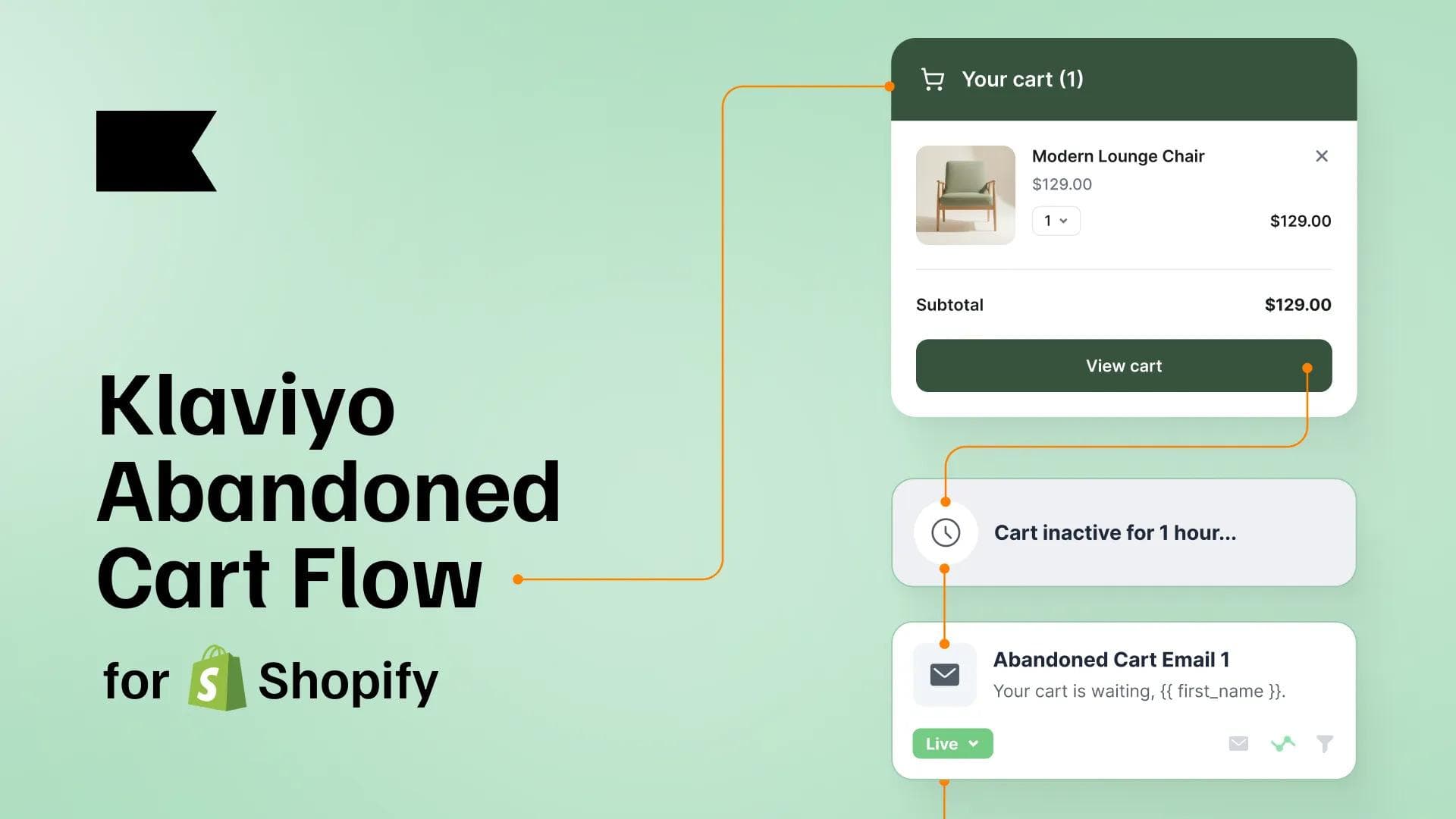
A visitor adds a product to their cart, gets distracted, and leaves. The sale looks lost, but the customer may still be ready to buy.
That is where a Klaviyo abandoned cart flow can recover revenue that would otherwise disappear. The important part is not simply turning on automation. The trigger, timing, message, offer, and follow-up all need to match the customer's buying intent.
Klaviyo's latest 2026 benchmark data shows why this flow deserves attention. Across more than 110,000 Klaviyo customers, abandoned cart flows produced the highest average revenue per recipient of all measured flows, at $6.77 for email and $4.48 for SMS. The top 10% of brands reached $13.70 and $8.69 respectively.
The opportunity is real, but better results come from treating cart recovery as part of the full customer journey, not as a few reminder emails.
What Is a Klaviyo Abandoned Cart Flow?
A Klaviyo abandoned cart flow is an automated series of messages sent to a shopper who adds a product to their cart or starts checkout but does not complete the purchase.
Klaviyo supports two main abandonment triggers:
- Added to Cart: Targets shoppers who added an item but did not necessarily start checkout.
- Started Checkout: Targets shoppers who moved further into the buying process but did not complete their order.
Klaviyo treats both as abandoned cart flows, but the customer's intent is different. Someone who started checkout has shown stronger buying intent than someone who only added a product to their cart.
That difference should influence the timing and message you send.
For Shopify stores, Klaviyo's Added to Cart flow requires the relevant behavioral tracking to be enabled. Klaviyo's standard abandoned cart flow uses the Started Checkout event, while an Added to Cart flow can be created separately for shoppers earlier in the funnel.
Why Does a Klaviyo Abandoned Cart Flow Matter?
Cart abandonment is not always a rejection of the product. People leave because they get distracted, want to compare options, need more information, are not ready to pay, or run into friction during checkout.
A reminder gives the customer another chance to complete the decision.
But there is an important CRO point here: the email should not be expected to fix a broken buying experience. If customers are leaving because shipping costs appear too late, the checkout is confusing, or the product page does not answer basic questions, sending another email only treats the symptom.
That is why cart recovery should sit alongside broader CRO, Conversion Research, and Checkout Optimization work.
The goal is not simply to recover more abandoned carts. It is to understand why the carts were abandoned in the first place and improve the parts of the customer journey that create the most lost revenue.
How Should You Set Up a Klaviyo Abandoned Cart Flow?
A good Klaviyo abandoned cart flow starts with the right event, clean data, and clear purchase exclusions. The setup should be tested before you worry about subject lines or creative.
1. Choose the right trigger
For a standard Shopify setup, Started Checkout is a strong starting point because the shopper has already moved further into the buying process.
You can also use Added to Cart to reach shoppers earlier. This can be useful when a large number of people add products but never begin checkout.
The two audiences should not automatically receive identical messages. The further someone has moved toward purchase, the less education they may need and the more direct the reminder can be.
2. Make sure the product data works
Your email needs access to the abandoned product information.
Test that the flow can correctly display the:
- Product name
- Product image
- Price
- Product URL
- Cart or checkout link
A beautifully designed email is useless if the dynamic product block is empty or the button sends the shopper to the wrong place.
3. Stop the flow after purchase
This is one of the most important parts of the setup.
A customer who has already purchased should leave the abandonment sequence. Klaviyo's guidance recommends using the Placed Order event to prevent messages from continuing after a purchase.
Test this yourself before the flow goes live. Enter the flow, place an order, and confirm that the remaining abandonment messages are skipped.
4. Check for duplicate messages
If your Shopify store, another email platform, or an older automation is already sending cart reminders, turn off the duplicate flow.
Klaviyo also recommends disabling default platform messages when they would duplicate your Klaviyo flow.
Customers should not receive three different abandoned-cart emails because three systems are trying to recover the same order.
What Is the Best Timing for a Klaviyo Abandoned Cart Flow?
There is no universal timing that works for every store. The best schedule depends on purchase intent, product price, buying cycle, and how quickly customers normally return.
For most stores, the first email should arrive while the product is still fresh in the shopper's mind, followed by one or two useful reminders.
A practical starting structure is:
- First email: Around 1–3 hours after abandonment.
- Second email: Around 20–24 hours later.
- Third email: Another 24–48 hours later, if the flow needs one.
This is a starting point, not a rule.
A $30 impulse purchase may need a faster sequence than a $400 product that requires research. A replenishable product may also behave differently from a product customers buy once every few years.
This is where A/B Testing becomes useful. Instead of copying a timing sequence from another brand, test the timing against your own customer behavior and measure completed purchases and revenue per recipient.
How Many Emails Should a Klaviyo Abandoned Cart Flow Have?
Three emails are a sensible starting point for many Shopify stores, but more emails do not automatically mean more revenue.
The first email should remind. The second should help the customer decide. The third should provide a final reason to return.
If all three emails say essentially the same thing, the additional messages add little value.
The flow should also fit into your wider Retention Marketing strategy. A customer may already be receiving welcome emails, campaigns, browse abandonment, SMS, or other lifecycle messages. The goal is to coordinate those touchpoints rather than keep adding messages.
What Should the First Abandoned Cart Email Say?
The first email should be simple. Remind the shopper what they left behind and give them a clear way to return.
Do not start with a discount unless there is a strong reason to do so. The customer already showed interest. Your first job is to remove the friction between that interest and completing the order.
Example:
Subject: Still thinking it over?
You left something behind.
Your selected items are still in your cart. If you're ready to continue, you can pick up where you left off.
CTA: Return to your cart
The product itself should do most of the work. Show the item clearly, keep the copy short, and make the path back to checkout obvious.
What Should the Second Abandoned Cart Email Say?
The second email should do more than repeat the reminder.
Think about the question stopping the customer from buying.
For apparel, it could be sizing. For skincare, ingredients or suitability. For supplements, usage or product benefits. For higher-priced products, it could be trust, returns, shipping, or product quality.
Use the second message to answer that concern.
Example:
Subject: Still deciding? Here's what to know
Not sure if it's the right fit?
Take another look at the product details, reviews, and what is included before you decide.
When you're ready, your cart is waiting.
CTA: Review your cart
The exact content should come from customer research rather than guesswork. Conversion Research can reveal the questions and objections that customers are actually raising.
Should the Third Email Offer a Discount?
Not necessarily.
Discounting is one of the easiest ways to make an abandoned cart flow look successful while quietly reducing profit.
If someone would have purchased without a discount, the coupon did not create an incremental sale. It simply reduced the value of the sale.
A better approach is to test the offer against alternatives. You might test:
- No discount
- Free shipping
- A fixed-dollar incentive
- A percentage discount
- A relevant bundle
- A gift with purchase
The right option depends on your margins and the reason customers abandon.
For example, if a shopper is $10 away from free shipping, improving the Free Shipping Thresholds may be more useful than giving them 15% off the entire order.
That turns cart recovery into an AOV decision as well as a retention decision.
Can You Add SMS to a Klaviyo Abandoned Cart Flow?
Yes, but SMS should add value rather than simply increase message volume.
Email gives you room to show products, explain benefits, and answer objections. SMS is better for short, timely reminders when the customer has given the required consent.
For example, an email could explain the product and answer common questions, while a later SMS simply reminds the customer that their cart is still available.
Klaviyo recommends planning email and SMS together rather than treating them as separate systems. Consent, frequency limits, and quiet hours also need to be handled correctly.
This is one reason a broader Klaviyo strategy matters. The cart flow should fit into the rest of the account instead of competing with other automated messages.
How Do You Personalize an Abandoned Cart Flow?
The most useful personalization is usually behavioral.
Show the actual products the customer considered. Use relevant product information. Adjust the message based on whether they are a first-time buyer or an existing customer when that distinction changes the message.
You can also segment based on factors such as cart value, product category, or customer status.
For example, a $40 first purchase may need reassurance about shipping and returns. A $500 cart from an existing customer may deserve a very different message.
The principle is simple: personalization should make the message more relevant, not just more personal.
How Can You Use Abandoned Cart Emails to Increase AOV?
Cart recovery does not have to mean recovering the exact cart at the exact value.
If the shopper already has strong purchase intent, you can sometimes increase the order value without hurting conversion.
Relevant tactics include:
- Showing a useful complementary product.
- Reminding the customer how close they are to a free-shipping threshold.
- Offering a bundle that makes more sense than buying products separately.
- Suggesting a larger pack when the product naturally supports it.
The key word is relevant.
Adding random products to an abandoned cart email can distract the customer from the purchase they were already considering. AOV optimization should make the larger order feel like the better decision, not force another sale into the email.
What Metrics Should You Track?
The most useful metric is not simply how many people opened the email.
Track whether the flow is creating profitable purchases.
Key metrics include:
- Placed order rate: How many recipients completed a purchase?
- Revenue per recipient: How much attributed revenue does the flow generate per delivered message?
- Conversion rate: How efficiently does the flow turn eligible shoppers into buyers?
- Average order value: Are recovered orders larger or smaller than your normal orders?
- Unsubscribe rate: Is the flow creating message fatigue?
- Incremental revenue: How much of the recovered revenue would probably not have happened without the flow?
Klaviyo defines revenue per recipient as attributed revenue divided by delivered messages, and its benchmark data shows that results vary significantly by brand and AOV.
That last point matters. A flow generating $5 in revenue per recipient is not automatically better than one generating $3 if the first relies heavily on discounts and produces lower-margin orders.
100xretention uses the same broader principle across Ecommerce Email: measure revenue, not vanity metrics.
How Should You A/B Test a Klaviyo Abandoned Cart Flow?
Test one meaningful question at a time.
You might test whether:
- A 1-hour delay beats a 3-hour delay.
- Product-focused copy beats benefit-focused copy.
- Reviews outperform feature explanations.
- Free shipping beats a percentage discount.
- Email-first beats SMS-first.
- One reminder performs better than three.
Do not change the timing, design, offer, subject line, and copy at the same time. If the result changes, you will not know why.
The same discipline used in onsite A/B Testing applies here. Start with a hypothesis, choose the metric before the test, let the test run long enough to produce useful evidence, and document what you learn.
The objective is not to find a prettier email. It is to find the change that produces more profitable revenue.
What Are the Most Common Klaviyo Abandoned Cart Flow Mistakes?
1. Sending the first email too late
The longer you wait, the more likely the customer's attention has moved elsewhere. Start with a reasonable delay, then test it against your own data.
2. Giving everyone a discount
A discount can recover some sales while damaging margin and training customers to wait for offers. Test whether the incentive creates incremental purchases before making it standard.
3. Using the same message three times
Each email should have a job. Reminder, objection handling, and final nudge are more useful than three versions of “You forgot something.”
4. Ignoring checkout problems
If customers regularly abandon because of shipping surprises, payment issues, or poor checkout UX, email is not the main problem. Fix the experience that caused the abandonment.
5. Forgetting to stop the flow after purchase
A customer who has already ordered should not receive another message telling them to finish their purchase. Test the purchase exclusion before launch.
6. Measuring only attributed revenue
Attribution can make a flow look stronger than its true incremental impact. Look at purchase behavior, margin, and holdout or comparison data where possible.
Klaviyo Abandoned Cart Flow Checklist
Before launching, make sure you have:
- Confirmed the correct trigger.
- Tested Shopify and Klaviyo event tracking.
- Checked that product data appears correctly.
- Added purchase exclusions.
- Removed duplicate abandonment messages.
- Tested every cart and checkout link.
- Checked the emails on mobile.
- Set reasonable delays between messages.
- Decided whether SMS actually adds value.
- Chosen the main metric before testing.
- Checked discounts against your margins.
- Reviewed the flow alongside other Klaviyo campaigns and automations.
How Does 100xretention Approach Abandoned Cart Recovery?
100xRetention does not treat an abandoned cart flow as an isolated email project.
The first question is where the revenue is actually being lost. That can mean looking at the Klaviyo account, customer behavior, Shopify data, checkout performance, product pages, and the wider lifecycle.
From there, the work can move across the three revenue levers: conversion, AOV, and retention.
On the retention side, that can mean rebuilding Klaviyo Flows, improving segmentation, and coordinating email and SMS. On the conversion side, it may mean fixing the product page or Checkout Optimization that is creating the abandonment. On the AOV side, it may mean improving bundles, cart offers, or shipping thresholds.
The point is to fix the biggest revenue problem first.
100xretention's Klaviyo approach starts with an account audit, then fixes data, segmentation, deliverability, and weak flows before building what is missing. Performance is reported on revenue per recipient and other business outcomes, not simply open rates.
That same thinking applies to CRO. The agency's testing process starts with research and a revenue-ranked experiment roadmap, then builds and tests variants before shipping the winners.
For a Shopify brand, that matters because abandoned cart recovery is only one part of the revenue picture. More recovered carts help, but so do more completed purchases, larger orders, and more customers coming back.
What Should You Do If Your Abandoned Cart Flow Is Not Working?
Start by finding the failure point instead of immediately rewriting the emails.
Check whether shoppers are entering the flow correctly. Then check whether the messages are reaching the right people, whether the cart links work, and whether purchases are stopping the sequence.
If the technical setup is working, look at the customer journey.
Are people abandoning before checkout? Are they leaving after seeing shipping costs? Are certain products responsible for most abandonment? Are high-value carts behaving differently from low-value carts?
Those answers tell you what to test next.
If you want an outside view, 100xRetention's Free Revenue Audit provides a recorded walkthrough of your three biggest revenue leaks within 3 business days. It looks beyond a single email flow and considers where conversion, AOV, and retention are leaving money on the table.
Conclusion
A strong Klaviyo abandoned cart flow does not need to be complicated.
Start with the right trigger. Send the first reminder while the purchase is still fresh. Use later messages to answer real objections instead of repeating the same reminder. Avoid automatic discounts, coordinate email and SMS, and measure the flow on revenue and profit rather than opens alone.
Most importantly, do not assume every abandoned cart is an email problem.
Sometimes the biggest opportunity is in the product page. Sometimes it is checkout. Sometimes it is the offer or shipping threshold. And sometimes the flow itself needs better segmentation and testing.
That is the difference between adding another automation and actually doing revenue optimization.
If you want to know where your Shopify store is losing revenue across CRO, AOV, and retention, Get a Free Revenue Audit. 100xretention will record a walkthrough of your three biggest revenue leaks and show you what to fix first.
Frequently asked questions
What is a Klaviyo abandoned cart flow?
A Klaviyo abandoned cart flow is an automated sequence that follows up with shoppers who add products to their cart or start checkout but do not purchase. The flow reminds them about the purchase and can address common objections before giving them another chance to complete the order.
How many emails should an abandoned cart flow have?
Three emails are a useful starting point for many Shopify stores. The first should remind the customer, the second should address a buying concern, and the third can provide a final reason to return. The right number depends on customer behavior, product type, and flow performance.
When should I send an abandoned cart email?
A first email around 1–3 hours after abandonment is a reasonable starting point. Follow-up timing should depend on the product and buying cycle. Test your timing rather than assuming a schedule that works for another ecommerce brand will produce the same result for your store.
Should I use Added to Cart or Started Checkout?
Started Checkout reaches shoppers with stronger purchase intent because they have already entered the checkout process. Added to Cart reaches shoppers earlier. For Shopify stores, both can be useful as separate flows when tracking is configured correctly.
Should abandoned cart emails include a discount?
Not always. A discount can reduce profit on customers who would have purchased anyway. Start by removing friction and answering objections. If price is a real barrier, test a discount or another offer against a non-discounted version and measure the impact on profitable revenue.
Can Klaviyo abandoned cart flows include SMS?
Yes. Klaviyo supports email and SMS in abandoned cart strategies, provided customers have the required SMS consent. Email and SMS should be planned together so customers do not receive duplicate or excessive messages.
Why is my abandoned cart flow getting clicks but few orders?
Clicks do not guarantee purchase intent. The problem may be the offer, product page, shipping cost, checkout experience, or mismatch between the email and the customer's concern. Look at the full journey from email click to purchase instead of optimizing the email in isolation.
How do I improve abandoned cart flow revenue?
Start with accurate tracking and purchase exclusions, then test timing, messaging, offers, segmentation, and channel order. Measure placed-order rate and revenue per recipient, but also consider margin and incremental revenue. The highest-value improvement may come from fixing the onsite experience that causes abandonment.
Find out where your store is losing revenue
Get a free revenue audit of your Shopify store. We show you the biggest conversion leaks and what to test first.
Get your free audit