Cross-Sell vs Upsell: The Difference and When to Use Each


[ Summarize with AI ]
If you have ever watched a customer buy one product and wondered whether to show them a better version or another product that goes with it, you are looking at the difference between cross-sell and upsell.
The distinction sounds simple. In practice, choosing the wrong one can make an offer feel irrelevant, interrupt the buying decision, or push a customer toward spending more when they were already close to buying.
The best ecommerce brands do not add upsells and cross-sells everywhere. They match the offer to what the customer is trying to accomplish, then present it at a point where it actually makes sense.
What is the difference between cross-selling and upselling?
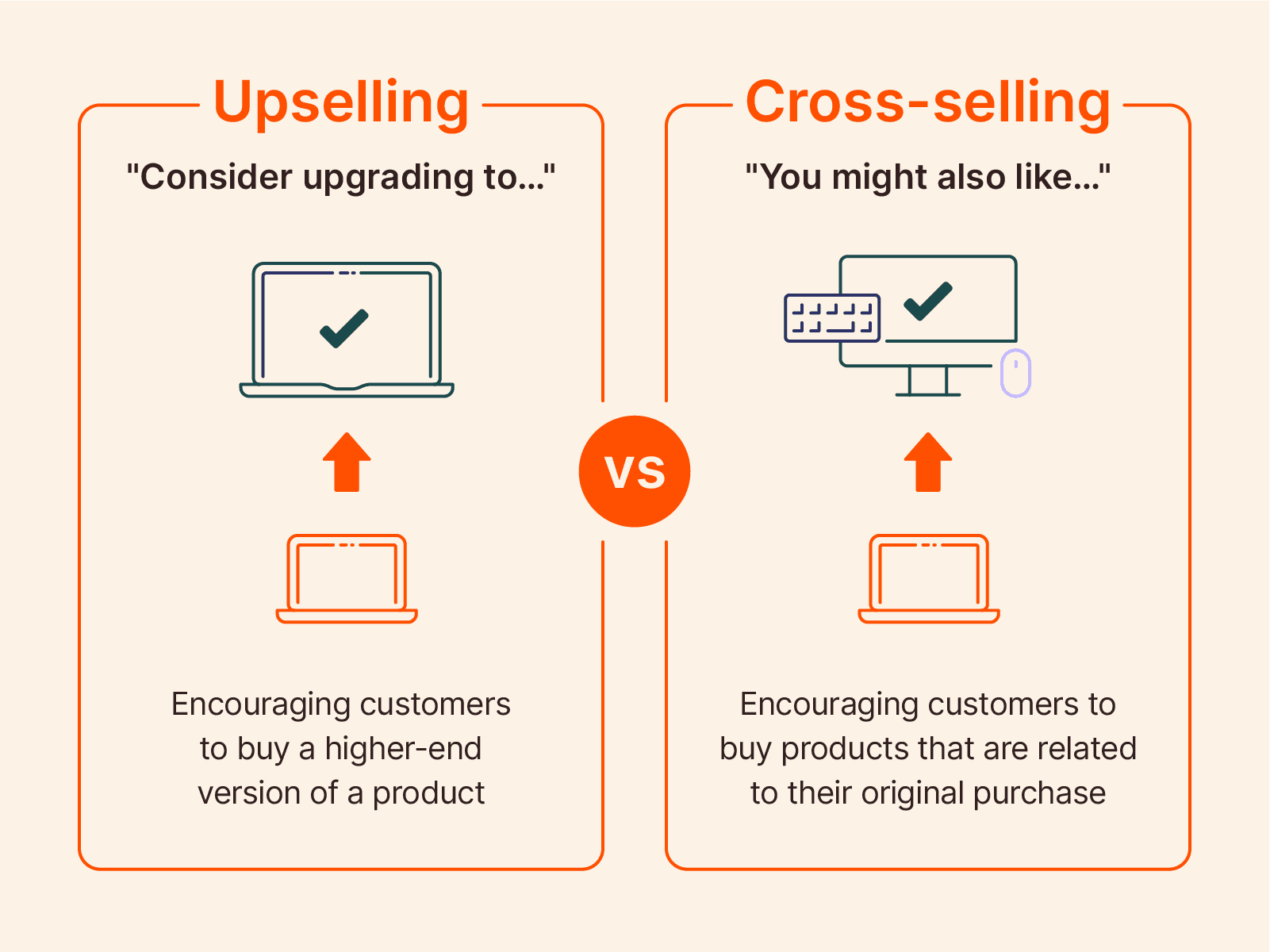
Upselling encourages a customer to choose a higher-value version of the product they are already considering. Cross-selling recommends an additional product that complements the original purchase.
A simple way to remember it:
- Upsell: Buy a better version.
- Cross-sell: Buy something that goes with it.
For example, if a customer is looking at a $60 pair of running shoes, offering a $90 premium version with better cushioning is an upsell. Offering running socks, insoles, or a shoe-care kit is a cross-sell.
Both can increase AOV, but they solve different customer needs. Shopify makes the same distinction in its current e-commerce guidance.
When should you use an upsell?
Use an upsell when the customer may genuinely benefit from a better, larger, more capable, or more valuable version of what they already want.
This works particularly well when the difference between products is easy to understand.
For example:
- A 13-inch laptop → a 15-inch laptop with better specifications
- A basic skincare bottle → a larger size
- A standard mattress → a premium model with better materials
- A single supplement pack → a larger supply
- A basic subscription → a higher-value subscription option
The important part is that the customer should still feel like they are buying the same solution, just at a higher level.
If the upgrade requires a completely different buying decision, it is probably not a strong upsell.
What makes an upsell work?
A good upsell usually has three things in common.
The difference is clear. Customers can quickly understand what they get for paying more.
The added value is meaningful. Better quality, more quantity, better features, longer coverage, or another tangible benefit gives the customer a reason to upgrade.
The price increase feels reasonable. Moving someone from a $50 product to a $55 or $65 option can feel natural. Moving them immediately to $150 may require a completely different sales argument.
The goal is not to show the most expensive product you have. It is to show the better option that makes sense for that customer.
When should you use a cross-sell?
Use a cross-sell when another product makes the original purchase more useful, complete, convenient, or enjoyable.
For example:
- Camera → memory card
- Running shoes → socks
- Coffee machine → coffee beans
- Laptop → protective sleeve
- Dress → matching accessories
- Skin cleanser → moisturizer
- Protein powder → shaker bottle
This is often where ecommerce brands can create the most natural additional revenue because the recommendation answers an obvious question:
What else does this customer need to get more value from what they just bought?
That is much stronger than simply showing another product because you want the order to be larger.
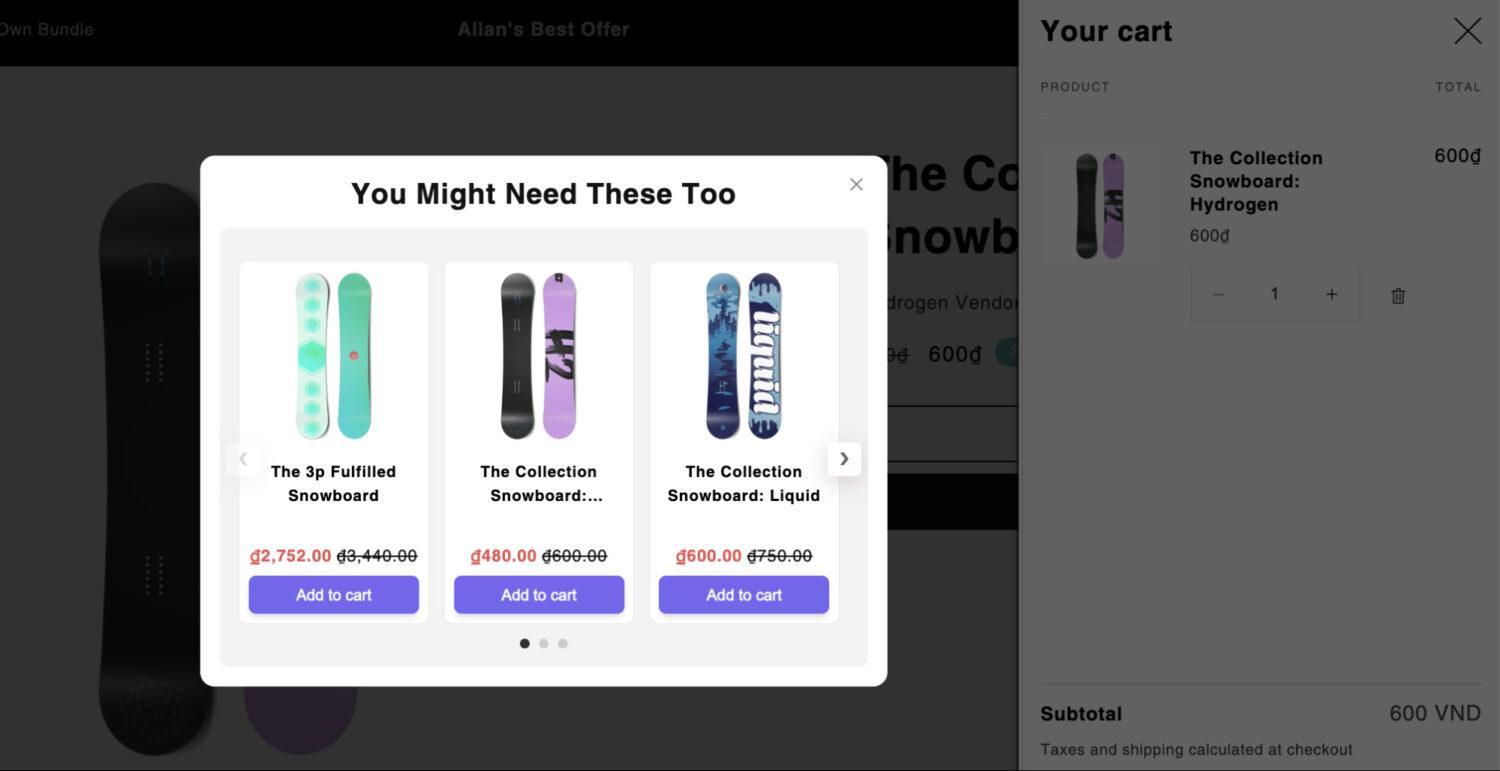
Shopify's current guidance similarly emphasizes complementary products, product recommendations, cart add-ons, and “frequently bought together” experiences as common cross-selling opportunities.
Cross-sell vs upsell: which one should you use?
There is no universal winner. The right choice depends on the customer's decision and your product catalog.
Use an upsell when:
- There is a clear premium version of the product.
- The higher-priced version solves the same need better.
- The value difference is easy to explain.
- The customer is still deciding which version to buy.
- The price increase is reasonable relative to the original product.
Use a cross-sell when:
- The customer has already chosen the main product.
- Another product naturally complements it.
- The additional item helps them use or enjoy the original purchase.
- The customer may not realize they need the additional item.
- The additional product does not require another major buying decision.
A useful rule is simple:
If you are changing the product, think upsell. If you are adding to the product, think cross-sell.
Where should you place upsell and cross-sell offers?
Placement matters almost as much as the offer itself.
An upsell often works best before the customer has committed to the original product. A cross-sell often becomes more natural after the customer has chosen the main product.
That is not an absolute rule, but it is a useful starting point.
On the product page
Product pages are a natural place for upsells because the shopper is still deciding what to buy.
You can show:
- Premium versions
- Larger sizes
- Better specifications
- Higher-tier options
- “Upgrade to” choices
For cross-sells, the product page can also introduce complementary products, particularly when the relationship is obvious.
In the cart
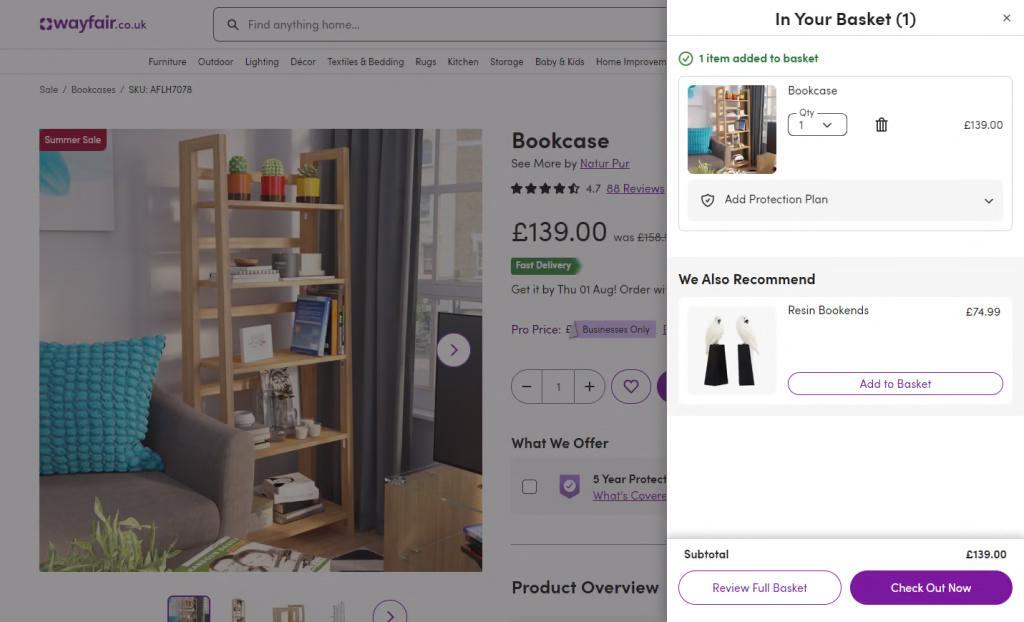
The cart is often a stronger environment for cross-selling.
The customer has already made a decision. Now you can ask whether they also need something that completes the purchase.
For example:
Complete your coffee setup with these filters.
or:
Add a protective case for your new camera.
This is different from showing five unrelated “recommended products.” The recommendation should have a reason for being there.
At checkout
Checkout requires more caution.
A customer who has reached checkout is already trying to complete the purchase. An offer that creates uncertainty or pulls attention away from the payment decision can do more harm than good.
The question should not be:
Can we put an upsell here?
It should be:
Does this offer make the purchase easier or more valuable without interrupting completion?
After purchase
Post-purchase offers are particularly useful because the original transaction has already been completed.
That means a relevant additional offer does not necessarily put the original order at risk.
For example, someone buys a coffee machine. After completing the purchase, you could offer a discounted supply of compatible coffee or filters.
Shopify also identifies post-purchase upsells as an opportunity to add relevant products after the original transaction, while warning that irrelevant or excessive offers can create fatigue.
What is a good ecommerce cross-sell example?
Imagine a customer buys a $100 skincare routine.
A weak cross-sell would be another unrelated $80 product simply because it has a good margin.
A better cross-sell would be:
- The moisturizer that complements the routine
- A travel-size version
- A product designed for the same skin concern
- A replenishment product they are likely to need later
The difference is relevance.
A good cross-sell makes the customer think, “I was probably going to need that anyway.”
That is the standard you should aim for.
What is a good ecommerce upsell example?
Imagine a customer is choosing between two protein products.
The standard product costs $40. The premium version costs $55 and contains more servings or has a meaningful additional benefit.
Presenting the $55 version with a clear explanation of what the customer gets for the extra $15 is an upsell.
The mistake would be presenting a completely unrelated product and calling it an upsell.
If the customer is not choosing between two versions of the same underlying solution, you may actually be looking at a cross-sell.
Should you offer a cross-sell or upsell before checkout?
Usually, choose based on the customer's level of commitment.
Before the customer has chosen a product, an upsell can make sense because you are helping them choose between versions.
After they have chosen the product, a cross-sell can make more sense because the main decision has already been made.
This is why a product page might say:
Upgrade to the Pro version
while the cart might say:
Add the compatible case
The customer's mental state is different at each point.
You should not treat every page as another opportunity to ask for more money.
How do you choose what products to cross-sell or upsell?
Start with your actual customer and order data instead of guessing.
Look for products that are frequently:
- Bought together
- Bought repeatedly
- Purchased shortly after another product
- Upgraded from one version to another
- Added when customers reach certain order values
Your product catalog can also reveal obvious relationships.
If customers frequently buy Product A and Product B together, that is a strong cross-sell candidate.
If customers frequently start with Product A and later move to Product B because Product B offers more capacity or features, that may be an upsell opportunity.
Shopify recommends using historical sales and purchase behavior to identify product pairings rather than relying entirely on intuition.
This is also where segmentation becomes useful. The best offer for a first-time buyer may not be the best offer for someone who has purchased from you five times.
How much should an upsell or cross-sell cost?
There is no universal percentage that works for every store.
The better question is whether the additional price feels proportionate to the original purchase and the value being added.
For a $50 product, a $10 to $20 complementary item may feel easy to add.
For a $500 product, a $50 accessory may be insignificant, while a $250 upgrade could require a much stronger value argument.
Price should be considered alongside:
- Product category
- Customer intent
- Original order value
- Perceived value
- Margin
- Purchase frequency
- Customer familiarity with the brand
Do not build an upsell strategy around an arbitrary rule such as “always recommend something 20% more expensive.”
Can bundles replace cross-sells and upsells?
Sometimes.
A bundle combines products or quantities into a single offer, often with a price advantage or other incentive.
For example:
Starter product: $50
Product + complementary accessory: $65
Complete bundle: $80
This can simplify the decision because the customer does not have to discover every additional product individually.
But bundles should not become an excuse to force products together.
The products should make sense as a group. If customers only want one item and the other items feel unnecessary, the bundle can create resistance instead of increasing value.
For stores looking specifically at order value, this connects closely with increasing AOV on Shopify, where the focus should be on increasing the value of each order without simply pushing customers to spend more.
How do upsells and cross-sells affect retention?
This is where the strategy becomes more important than the immediate AOV increase.
A customer may accept an offer today, but that does not automatically make the customer more valuable.
A relevant cross-sell can improve the customer's experience because they have everything they need to use the main product. A useful upsell can help them choose a product they will be happier with.
An irrelevant offer does the opposite. It can make the brand feel more focused on extracting revenue than helping the customer.
That matters because retention is not just about sending another email later. The experience surrounding the first purchase influences whether the customer wants to come back.
A good cross-sell can therefore do two jobs at once:
- Increase the current order value.
- Improve the customer's experience with the original purchase.
That second outcome is easy to overlook.
What should you measure?
Do not judge an upsell or cross-sell only by how much additional revenue it generates.
At minimum, track:
- Offer view rate
- Acceptance rate
- Revenue per visitor
- Revenue per order
- AOV
- Conversion rate
- Original-product conversion rate
- Refund or cancellation rate
- Repeat purchase rate
- Customer lifetime value
The key question is whether the incremental revenue is actually incremental.
For example, if a cross-sell produces $20,000 in additional sales but causes enough shoppers to abandon the original purchase, the headline revenue number is misleading.
You also want to know whether the customers accepting offers behave differently later.
Do they reorder more often? Do they have higher lifetime value? Do they request more refunds? Do they become better customers?
That is a much more useful view of the strategy.
What does a strong upsell and cross-sell strategy look like?
It starts with the product, not the widget.
First understand what customers buy, what they buy together, what they upgrade to, and what they need after the first purchase.
Then decide where the recommendation belongs.
A simple framework is:
1. Understand the main purchase.
What is the customer actually trying to accomplish?
2. Identify the next logical value.
Is there a better version, or is there something that complements it?
3. Match the offer to the buying stage.
Upsell while they are choosing. Cross-sell when the main purchase is established. Post-purchase offers can work when the additional product is genuinely useful.
4. Keep the choice simple.
One strong recommendation is often better than a wall of products.
5. Measure the whole customer journey.
Look beyond AOV and immediate revenue.
This is much more effective than installing an upsell app and adding offers to every available location.
What mistakes should you avoid?
The most common mistake is treating every customer as an opportunity to spend more.
Avoid:
- Showing unrelated products
- Offering too many products at once
- Using the same recommendation for every customer
- Making the upgrade difference difficult to understand
- Pushing expensive upgrades without explaining the value
- Interrupting checkout with unnecessary offers
- Measuring only immediate upsell revenue
- Discounting every cross-sell
- Ignoring what customers actually buy together
- Continuing to show products customers already own
- Letting third-party widgets slow down the shopping experience
That last point matters more than it gets discussed. Recent Shopify merchants discussing upsell and cross-sell tools have raised concerns around heavy scripts, cart performance, poor targeting, discounts not carrying correctly, and products or variants behaving incorrectly through checkout.
The tool is not the strategy.
How can cross-selling and upselling increase AOV without hurting the customer experience?
The best approach is to stop thinking about upsells and cross-sells as “ways to get customers to spend more.”
Think of them as ways to help customers make a better purchase.
If someone is buying a product that works better with an accessory, recommend the accessory.
If there is a better version that genuinely fits what they need, explain the upgrade.
If neither is relevant, do nothing.
That restraint matters.
One useful offer can increase order value. Five irrelevant offers can make the entire store feel harder to shop.
For example, the work done for Jot shows what can happen when AOV is treated as a broader customer journey rather than a simple “add another product” tactic. The brand achieved a 126% increase in AOV through subscription and CRO strategies. The lesson is not that every brand should copy the same offer. It is that increasing order value works best when the offer fits how customers actually buy.
For brands that want to make this a systematic part of their growth strategy, AOV optimization can bring product merchandising, bundles, upsells, and offer strategy into one framework.
How should cross-selling and upselling connect with retention?
An order is not the end of the customer journey.
If the customer buys a replenishable product, a cross-sell might introduce something they will need for the next purchase.
If the product works well as part of a routine, a bundle can make that routine easier.
If a customer is likely to reorder, the post-purchase experience can introduce the next relevant product at the right time rather than immediately pushing another offer.
This is where retention marketing becomes connected to AOV.
The objective is not to maximize the first order at any cost. It is to increase the total value of the customer relationship.
Conclusion
Cross-selling and upselling are different tactics, but neither is automatically better.
Use an upsell when a customer would benefit from a better version of what they already want. Use a cross-sell when another product naturally complements the purchase.
Then pay attention to timing, relevance, price, and customer behavior.
The strongest strategy is usually not the one with the most offers. It is the one that makes the next purchase feel obvious.
If you are trying to understand where your store is leaving revenue on the table across AOV, conversion, and retention, a Revenue Audit can help identify which opportunities are actually worth prioritizing.
Frequently asked questions
Is cross-selling better than upselling?
Neither is universally better. Upselling works when a customer may want a better version of the product they are considering. Cross-selling works when another product naturally complements the main purchase. The better tactic depends on the product, customer intent, and buying stage
What is an example of cross-selling in ecommerce?
A common example is selling a laptop with a protective sleeve or a camera with a memory card. The additional product is not a better version of the original product. It complements the original purchase.
What is an example of upselling in ecommerce?
An example is offering a customer a larger size, premium version, or higher-specification product instead of the version they initially considered. The customer is still buying the same underlying type of product, but at a higher value.
Should upsells come before or after cross-sells?
There is no strict rule, but upsells often work well while the customer is deciding which version to buy. Cross-sells often become more natural after the main product has been selected, such as in the cart or after purchase.
Can cross-selling increase customer retention?
It can, when the recommendation genuinely improves the customer's experience. A complementary product can help customers get more value from their original purchase. An irrelevant recommendation can have the opposite effect, so retention should be measured alongside immediate revenue.
How do I know which products to cross-sell?
Start with purchase data. Look for products customers frequently buy together, products purchased shortly after another item, and products that naturally complete the same use case. Your best cross-sells should be based on customer behavior and product relationships, not simply which products have the highest margins.
Should every ecommerce store use upsells?
No. An upsell is useful only when there is a meaningful higher-value option. If the product has no natural upgrade, forcing one into the buying journey can create unnecessary friction. A relevant cross-sell or no offer at all may be better.
What should I measure for upsells and cross-sells?
Track acceptance rate, AOV, revenue per visitor, conversion rate, and incremental revenue. Also monitor refunds, cancellations, repeat purchase rate, and customer lifetime value. An offer that increases AOV but damages conversion or retention is not necessarily a successful offer.