Failed Payment Recovery: The Cheapest Churn You Will Ever Fix

[ Summarize with AI ]
A customer can love your product, want their next shipment, and still disappear because their card failed.
That is what makes failed payment recovery different from most retention work. The customer did not necessarily decide to leave. They already subscribed and expected the next charge to happen. The payment simply did not go through.
If you want to identify where your store is losing revenue across conversion, AOV, and retention, start with a Revenue Audit.
What is failed payment recovery?
Failed payment recovery is the process of recovering a recurring payment after the original charge fails. It can involve automatic retries, payment-method updates, customer notifications, and decisions about whether to pause or cancel the subscription if the payment remains unresolved.
The goal is not simply to collect one failed charge. It is to recover the revenue without unnecessarily losing a customer who still wants the product.
This process is also commonly called dunning. Dunning is the broader process of communicating with a customer about an overdue or failed payment. Failed payment recovery focuses on the outcome: getting the payment recovered and keeping the subscription from becoming unnecessary churn.
That distinction matters because a failed payment is not automatically churn. If the payment is recovered, the customer never really left. If the payment is never recovered and the subscription eventually ends, that becomes involuntary churn.
Why is failed payment recovery one of the cheapest churn problems to fix?
Failed payment recovery can be cheaper to fix than many other retention problems because the customer has already decided to buy again.
The customer may have been subscribed for months. Their card expired, their bank declined the transaction, their account lacked funds at that moment, or the payment required an action they never completed.
You are not trying to convince a new customer to buy. You are trying to collect revenue from someone who already intended to continue.
That does not mean every failed payment is recoverable. It means the first question should be how much of the failed revenue is realistically recoverable before treating it as churn.
This is also why failed payments should not be buried inside a general churn number. Voluntary cancellation and payment failure are different problems and usually require different fixes.
How much revenue are failed payments costing you?
The easiest way to quantify the problem is to compare failed-payment revenue with recovered revenue.
Start with four numbers:
Failed-payment revenue: the total value of recurring charges that failed.
Recovered revenue: the amount eventually collected from those failed charges.
Recovery rate: recovered revenue divided by failed-payment revenue.
Involuntary churn: the customers or recurring revenue eventually lost because payment was never recovered.
For example, if $30,000 of recurring charges fail during a month and $18,000 is eventually recovered, the recovery rate is 60%. The remaining $12,000 is the revenue that needs investigation.
That is where the analysis becomes useful.
Was most of the unrecovered revenue caused by expired cards? Were customers receiving payment-update messages but not completing the update? Were some payments being canceled before there had been enough time to recover them? Were certain failure reasons consistently unrecoverable?
A blended recovery rate will not answer those questions.
What is the difference between failed payment rate and recovery rate?
Failed payment rate tells you how often recurring payments are failing. Recovery rate tells you how effectively the business recovers the payments that do fail.
A store can have a relatively high payment failure rate but a strong recovery system. Another store can have fewer failed payments but lose a large percentage of the revenue behind them.
That is why both numbers belong in the retention dashboard.
How does silent recovery differ from customer-assisted recovery?
Silent recovery happens when a failed payment is recovered without the customer doing anything. A later retry may succeed, or the payment method may be updated automatically.
Customer-assisted recovery happens when the customer needs to replace a card, authenticate a payment, or correct their billing information.
Separating the two tells you where the real opportunity is. If automatic recovery is strong but customer-assisted recovery is weak, the payment-update journey may be the problem. If both are weak, the issue may be deeper in the retry strategy or billing setup.
Why do recurring payments fail?
Recurring payments fail for different reasons, so the recovery action should depend on the reason for the failure.
Why the payment failed | Should you retry? | What the customer needs to do |
Expired or replaced card | Usually not until payment details are updated | Update the payment method |
Insufficient funds | Usually yes | Nothing immediately, unless another payment method is needed |
Temporary bank or processor decline | Often | Wait for another attempt or contact the bank if it continues |
Invalid payment information | No | Enter a valid payment method |
Authentication required | Not until the required action is completed | Complete authentication or confirm the payment |
Hard decline or unsupported payment method | Usually not | Contact the bank or use another payment method |
The important point is that not every failed payment deserves the same recovery sequence.
Why do expired or replaced cards cause failed subscription payments?
The customer may have received a new card while the subscription still has the old payment details.
This is one of the more straightforward problems to address because payment systems can sometimes update stored card information automatically. When they cannot, the customer needs a simple way to replace the payment method.
Why can a payment fail when the customer has enough money?
A payment can be declined even when the customer has funds available. The bank may block the transaction, the payment method may not support the recurring charge, or the transaction may require authentication.
The available balance is therefore only one part of the diagnosis.
Why do recurring payments fail when the card worked for the first order?
A card working for a one-time purchase does not guarantee that a later recurring charge will succeed.
The recurring transaction can be treated differently by the issuer, the payment method may have changed, or the customer's bank may apply a different authorization or fraud rule.
That is why the original order being successful does not mean a later subscription charge should be assumed to be valid.
Should you retry every failed payment?
No. Retry only when another attempt has a reasonable chance of succeeding.
A temporary insufficient-funds issue may justify another attempt. An expired card requires an update. A hard decline may require customer intervention rather than repeated automated attempts.
This is why a fixed rule such as “retry every failed payment three times” is weaker than a recovery strategy based on failure reason.
Timing matters too. A payment that fails today may succeed later because the underlying issue has changed. But repeatedly charging a payment method that clearly needs to be replaced creates unnecessary attempts without addressing the actual problem.
The objective is not to maximize retry attempts. It is to maximize recovered revenue per failed payment while keeping the customer experience reasonable.
What should happen when a payment fails?
The recovery process should identify the failure, attempt the right recovery action, tell the customer what to do when necessary, and define what happens if recovery fails.
A good flow answers four questions:
What happened? Identify the payment failure and, where possible, its reason.
Can it be recovered automatically? Retry when appropriate or use available payment-update mechanisms.
Does the customer need to act? If the payment method needs to be replaced or authentication is required, make that action obvious.
What happens if recovery fails? Define when the subscription will pause, cancel, or move into another state.
These pieces need to work together. A recovery email cannot compensate for a poor payment-update experience, and a good payment-update page cannot compensate for canceling the subscription before the recovery process has had enough time to work.
The customer should experience this as one simple process, even if several systems are working behind the scenes.
If failed payments are already showing up as a meaningful revenue leak, book a call with 100xRetention to look at the recovery journey and determine where the money is being lost.
What should a failed payment email say?
A failed payment email should explain what happened, tell the customer whether their subscription is still active, and give them one clear next step.
The email should not make the customer investigate the problem themselves.
What should the first failed payment email say?
The first message should be calm and direct. The customer may not have done anything wrong, so there is no reason to make the message sound like a collections notice.
Subject: Your payment needs attention
Your latest subscription payment could not be processed, but your subscription is still active.
Please update your payment method below. Once it is updated, the payment can be processed again.
Update payment method
What should the payment recovery reminder say?
The second message should create more urgency while keeping the action simple.
Subject: Keep your subscription active
Your subscription payment is still outstanding.
Your subscription has not been canceled, but we need an updated payment method to keep your next order on schedule.
Update payment method
What should the final failed payment email say?
The final message should make the consequence clear rather than using vague urgency.
Subject: Final reminder: update your payment method
We still could not process your subscription payment.
Please update your payment method to keep your subscription active. If the payment is not resolved, your subscription may be paused or canceled.
Update payment method
What should the failed payment SMS say?
SMS should be shorter than email and focused on one action.
Your [Brand] subscription payment could not be processed. Update your payment method to keep your subscription active: [link]
The copy is only part of the recovery experience. If the customer clicks the message and has to search through their account to find the failed subscription, the flow still has friction.
How many failed payment emails should you send?
There is no universal number. The sequence should give the customer a reasonable opportunity to fix the problem without turning billing recovery into repeated pressure.
A practical structure is an initial notification when the payment fails, a reminder while recovery is still possible, and a final message before the subscription is paused or canceled.
The messages should also become more specific as the recovery window progresses.
The first message explains the problem. The second reinforces the action required. The final message explains what will happen if the customer does nothing.
Sending several versions of the same “payment failed” message is not a strategy. Each communication should have a purpose.
Should you use SMS for failed payment recovery?
SMS can be useful when email recovery is weak, the subscription has meaningful value, or the customer needs to take a simple action quickly.
It should not automatically be added to every failed payment. The right question is whether SMS produces enough additional recovered revenue to justify the extra communication.
That makes SMS a testable retention decision rather than a channel preference.
How long should you give customers to recover a failed payment?
Give customers enough time for reasonable retries and payment updates to work, but do not keep unpaid subscriptions active indefinitely.
The correct recovery window depends on the business. A monthly physical subscription has different economics from a digital subscription. A subscription that continues shipping products while unpaid may need a shorter window than one where access can safely be paused.
The useful question is:
How long can the subscription remain recoverable without creating unacceptable financial or operational risk?
That should determine the recovery window, not an arbitrary industry rule.
Is the payment update experience costing you recoveries?
Yes, if customers are being asked to take too many steps to fix the problem.
Imagine a customer receives a failed-payment email, clicks the link, logs in, opens their account, finds their subscription, searches for billing settings, replaces an expired card, and then has to figure out whether the failed invoice will be charged again.
Every additional step creates another opportunity to abandon the recovery process.
The ideal experience is much simpler. The customer should understand what failed and have a direct path to fix it.
This is particularly important on mobile because many failed-payment notifications will be opened away from a desktop.
Payment recovery is still conversion optimization. The conversion simply happens to be recovering an existing payment rather than creating a new order.
What should you measure?
Measure both the revenue entering recovery and what happens to it afterward.
Track:
Failed payment rate: failed recurring payment attempts divided by total recurring payment attempts.
Failed-payment revenue: the dollar value entering recovery.
Recovered revenue: the actual revenue brought back.
Recovery rate: recovered failed-payment revenue divided by failed-payment revenue.
Recovery time: how long it takes to recover a failed payment.
Involuntary churn: customers or recurring revenue lost because payment was not recovered.
Recovery by failure reason: compare expired cards, insufficient funds, issuer declines, authentication failures, and other categories.
Silent vs. assisted recovery: separate payments recovered without customer action from those recovered after the customer updated their payment method or took another action.
These metrics tell you where to focus.
If expired cards make up most of the failed revenue, improving card updates may matter more than writing better emails. If customers click recovery emails but do not complete payment updates, the destination experience may be the problem. If most failures recover automatically, failed payment recovery may not be the biggest retention opportunity.
That is the difference between measuring failed payments and diagnosing them.
What should you test in failed payment recovery?
Start with the largest measurable leak rather than testing everything at once.
Useful tests include retry timing, failure-specific recovery, the payment-update destination, email timing, email sequence length, CTA language, SMS, and pause versus cancellation.
The primary metric should be recovered revenue or retained subscription revenue, not email opens or clicks.
A recovery email can have excellent engagement and still produce very little money if customers abandon the payment-update process.
How does Shopify handle failed subscription payments?
Shopify Subscriptions lets merchants configure the number of billing retry attempts, the days between retries, and what happens after all attempts fail. The subscription can be skipped, paused, or canceled depending on the settings.
That means Shopify merchants do not have to build the basic retry logic from scratch. The bigger question is whether the default recovery setup is appropriate for the store's subscription economics and customer journey.
The wider Shopify subscription ecosystem adds more recovery controls.
How does Recharge handle failed subscription payments?
Recharge provides automatic recovery settings for failed charges and can retry eligible charges after a payment-method update. It also provides reporting on charge errors, which can help merchants understand why payments are failing.
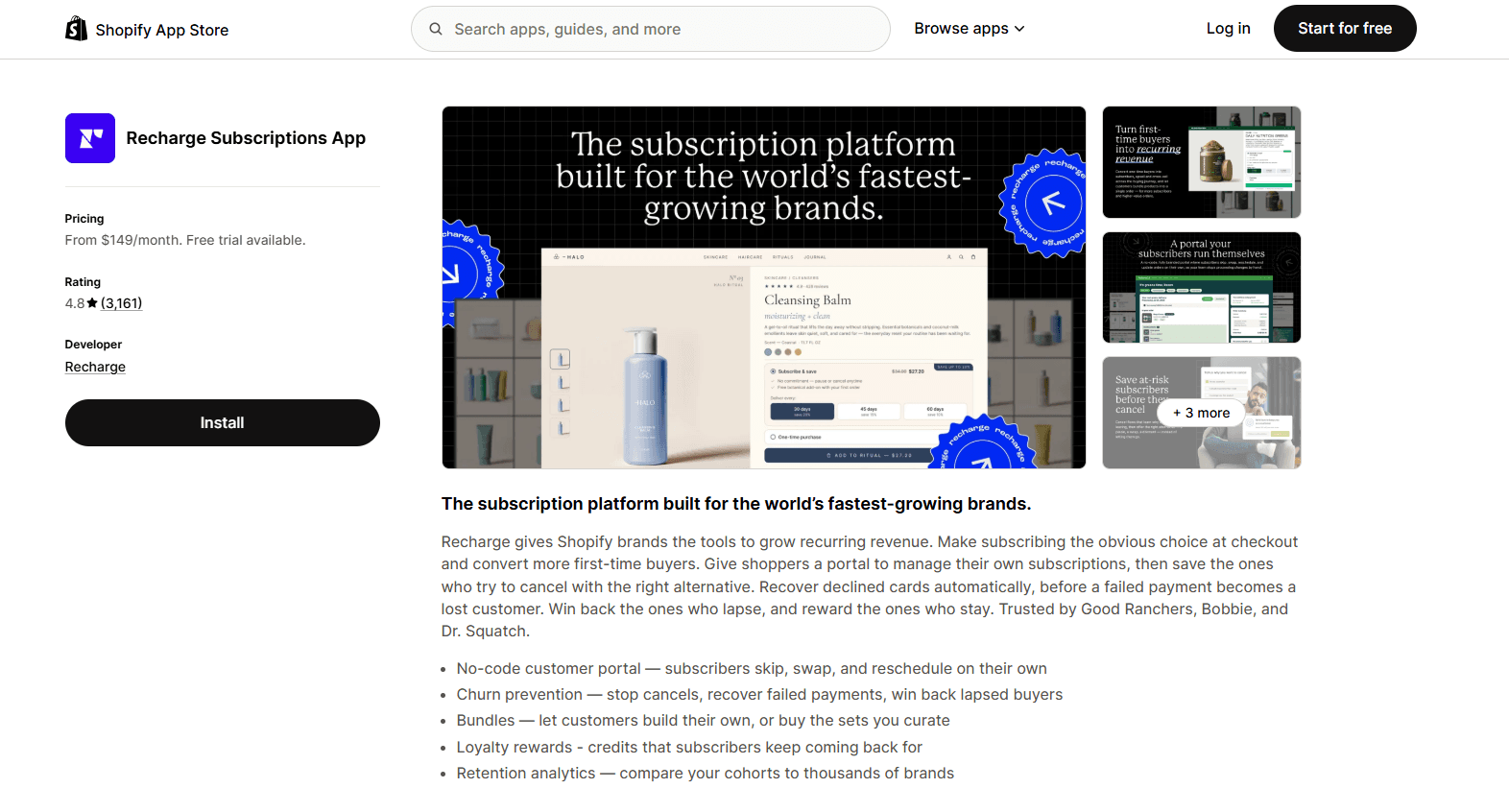
Recharge is available through the Shopify App Store and lists Failed Payment Recovery as a feature of its subscription platform.
How does Skio handle failed subscription payments?
Skio provides a dedicated Payment Recovery system with configurable retry phases and retry intervals. It also exposes the payment error returned by Shopify or the payment provider, which can help merchants separate problems such as insufficient funds, invalid payment methods, and authentication issues.
The useful part is not simply having more retry settings. It is being able to change the recovery path based on what actually caused the payment to fail.
How does Loop handle failed subscription payments?
Loop uses Shopify's billing infrastructure for subscription payment processing and surfaces payment errors returned by Shopify. It also provides payment-recovery settings and tools for getting customers to update their payment methods.
What does this mean for a Shopify store?
The important point is that Shopify subscription apps are not identical, but they solve the same basic problem in different ways.
Shopify Subscriptions provides the core billing-attempt controls. Recharge, Skio, and Loop add different levels of recovery logic, error handling, customer communication, and reporting.
The app is only part of the system. A store can have sophisticated retry settings and still lose revenue if customers cannot easily update their payment method or if the recovery sequence communicates the wrong message at the wrong time.
What are the biggest failed payment recovery mistakes?
The biggest mistake is treating failed payments as a normal amount of churn that cannot be controlled.
The second is using one recovery process for every failure reason. A temporary decline, an expired card, and a payment requiring authentication are different problems.
The third is making the customer work too hard to fix the problem. If the recovery message is easy to understand but the payment-update journey takes several steps, the system still has a conversion problem.
Another mistake is canceling too early. If the customer intended to continue, immediate cancellation creates churn that did not need to happen.
Finally, many businesses track total churn without separating voluntary cancellations from payment-related losses. That makes it harder to know whether the retention problem is the product, the offer, the customer experience, or simply the billing recovery process.
How should failed payment recovery fit into retention?
Failed payment recovery should be part of the retention system, not a separate finance task that nobody owns.
The process starts before the payment fails. Good subscription management, accurate billing information, payment-update capabilities, and clear renewal communication can prevent some failures from becoming churn.
When a payment does fail, the recovery system should identify the reason, attempt appropriate automatic recovery, ask the customer to act when necessary, and keep the subscription recoverable for a sensible period.
After the payment is recovered, the customer should simply return to the normal lifecycle.
That makes failed payment recovery closely related to subscription and loyalty optimization and email and SMS retention, but it should not be confused with voluntary churn. A customer who cancels because they no longer want the product needs a different intervention from a customer whose card stopped working.
If you are seeing both problems, reducing subscription churn should address the voluntary side while payment recovery addresses the involuntary side.
How does 100xRetention approach failed payment recovery?
100xRetention starts by finding how much revenue is actually being lost and where recovery is breaking down.
That means looking at failed-payment volume, failure reasons, recovery rate, recovery time, customer value, retry behavior, payment-update friction, and the point at which subscriptions eventually pause or cancel.
From there, the highest-value leak can be addressed.
Sometimes the problem is retry timing. Sometimes it is an outdated payment method. Sometimes the customer receives the message but cannot easily update their card. Sometimes the subscription is canceled before there has been a reasonable opportunity to recover it.
And sometimes failed payments are not the biggest retention problem at all.
That is why the analysis should start with the revenue rather than assuming the solution.
Conclusion
Failed payment recovery matters because the customer may already have decided to stay. The payment failed, but the relationship did not necessarily end.
A strong recovery system distinguishes failure reasons, uses appropriate retries, makes payment updates easy, gives the customer a sensible recovery window, and measures recovered revenue separately from genuine customer cancellations.
The most useful number is not how many failed payments occurred. It is how much of the revenue behind those failures was recovered, how quickly, and why the rest was lost.
If failed payment recovery is costing meaningful recurring revenue, request a Revenue Audit to identify the largest recovery and retention opportunities across the customer journey.
Frequently asked questions
How many times should you retry a failed payment?
Usually 2–4 retries over several days, depending on the failure reason. Hard declines should not be repeatedly retried.
What is a good failed payment recovery rate?
There is no universal benchmark. Track recovery by payment failures and recovered revenue, then compare performance over time by failure type and customer segment.
How does Shopify handle failed subscription payments?
Shopify Subscriptions can retry failed payments and lets merchants configure retry attempts, timing, and what happens when recovery fails.
Why did my payment fail if my card has not expired?
Payments can fail because of insufficient funds, bank declines, incorrect payment details, authentication issues, or temporary issuer problems.
Should you offer a discount to recover a failed payment?
Usually no. If the customer already wants the product, fix the payment problem first. Discounts can reduce margin without solving the underlying issue.
When should a failed payment become churn?
After the recovery window and reasonable payment reminders have been exhausted. At that point, the subscription should be treated as involuntary churn rather than an active recovery opportunity.