How to Reduce Subscription Churn

[ Summarize with AI ]
A cancellation popup with 20% off is the easiest churn fix to launch. It is also rarely the best place to start.
Some of your subscribers never chose to leave. Their card failed and nobody got them back. Others simply have too much product at home, so cancelling feels like the only way to stop the next box.
If you want to reduce subscription churn, work in this order: recover failed payments, help new subscribers get value from the first few orders, give people easy ways to skip, pause or change their schedule, and only then add save offers. Here is how to do each one.
What is subscription churn?
Subscription churn is the percentage of subscribers who stop their subscription during a specific period.
For ecommerce brands, it helps to separate churn into two categories:
- Voluntary churn: The customer actively cancels.
- Involuntary churn: The subscription ends because of a failed payment, expired card, payment issue, or another billing problem.
That distinction matters because the fixes are completely different.
A customer who says, "I have too much product" does not need a payment recovery email. A customer whose card was declined does not need a 20% discount.
How can you reduce subscription churn?
Start with the problems closest to lost revenue and work outward.
- Recover failed payments and reduce involuntary churn
- Improve onboarding and the first few orders
- Give customers control with skip, pause, swap, and frequency changes
- Use targeted cancellation save offers
Most brands start at number four because it is visible. A cancellation flow is easy to build and a discount feels like an obvious solution.
But if a customer's card failed, a discount does nothing. If they have three unopened boxes at home, a discount may make the next shipment even less useful. If they never learned how to use the product properly, another offer does not solve the underlying problem.
The order matters.
Why should you fix involuntary churn first?
Fix involuntary churn first because those customers never chose to leave. Their card expired or was declined, so a discount is the wrong tool. Payment recovery is the right one. It is also the cleanest win: you are bringing back people who already want the product instead of persuading people who have decided to go.
Look at failed payments separately from voluntary cancellations.
You want to know:
- How many renewals failed?
- Why did they fail?
- How many customers recovered?
- How quickly were they recovered?
- How much recurring revenue was saved?
- How many customers still churned after recovery attempts?
Payment recovery should include automatic retries where supported, clear customer notifications, and an easy way to update payment information.
Card expiry reminders can also help where your subscription platform supports them.
Do not only look at total subscription churn. If involuntary churn is mixed into the same number as voluntary cancellations, you can end up spending time trying to persuade customers who never intended to leave.
Why does onboarding affect subscription churn?
Better onboarding reduces churn by helping customers understand the product, use it correctly, and reach value before the next renewal.
The first subscription order is not just another transaction. It starts the customer's expectation of what the recurring relationship will feel like.
A useful onboarding sequence should answer simple questions:
- What should the customer do first?
- How should they use the product?
- What result should they expect?
- When should they expect to notice that result?
- What should they do if something is not working?
- When should they expect their next shipment?
This matters particularly for products that require education or a habit.
A customer who buys a supplement, skincare product, food subscription, or household consumable may need more than a shipping confirmation. They need enough guidance to make the product part of their routine.
Track retention at the first few milestones instead of waiting for overall churn to tell you there is a problem.
For example, compare:
- First order to second order
- Second order to third order
- First 30 days
- First 60 to 90 days
- Customers who engaged with onboarding vs. those who did not
If customers disappear before the second or third order, the problem may be happening much earlier than the cancellation page.
How can skip, pause, and frequency changes reduce churn?
Skip, pause and frequency changes reduce churn by giving customers a smaller step than cancelling. Many people leave because they have too much product, are travelling, or need a quiet month. If they can skip one order or slow their schedule in a couple of clicks, they can keep the subscription instead of leaving.
For example, a customer receiving a product every 30 days may simply need it every 60 days.
If the only options are:
Keep receiving it every 30 days
or
Cancel
you are forcing a permanent decision when the customer's problem may only be temporary.
Give customers options such as:
- Skip the next order
- Pause for a specific period
- Change delivery frequency
- Reduce quantity
- Swap the product
- Move the next delivery date
This is not about making cancellation difficult. It is about giving customers a reasonable alternative to cancellation.
A good subscription experience lets the customer solve the problem without having to leave.
What should you offer for each cancellation reason?
The best retention action depends on why the customer is leaving. Do not show every customer the same discount.
Cancellation reason | Signal you may see | First action | When a discount makes sense |
Too much product | Repeated skips or long gaps | Skip, pause, or extend frequency | Rarely |
Wrong timing | Travel, temporary need, excess stock | Skip or pause | Rarely |
Too expensive | Price mentioned as the reason | Lower-cost option or targeted offer | When price is genuinely the issue |
Product dissatisfaction | Complaints, refunds, poor feedback | Fix product or customer experience | Usually not |
Product fatigue | Swaps, declining engagement | Offer another product or change cadence | Sometimes |
Payment failure | Declined or expired payment | Recover payment | No |
No longer needed | Customer says the need has ended | Make cancellation easy | Usually not |
This is why the cancellation reason matters.
You are not trying to stop every cancellation at any cost. You are trying to save customers when there is a legitimate way to solve the problem.
Why should save offers come last?
Save offers come last because a discount only fixes one reason for leaving: price. It does nothing for a customer who has too much product, is away, or wants a different flavor. Match the offer to the reason the customer gives, and use a discount only when cost is the real problem.
A cancellation flow can ask one simple question:
Why are you cancelling?
The options might include:
- Too much product
- Too expensive
- Do not need it right now
- Want a different product
- Product did not work for me
- Shipping or delivery issue
- Other
Then respond to the reason.
Someone with too much product might see:
"Need a break? Skip your next shipment or change your delivery schedule."
Someone who thinks the product is too expensive might see a targeted offer.
Someone who wants a different product might see an option to swap.
Someone who simply does not want the subscription anymore should be able to cancel without being trapped in a sequence of offers.
That last point matters. A retention flow should make cancellation clear, not deliberately hide it.
How should you build a cancellation flow?
A good cancellation flow asks for the reason, gives the most relevant alternative, and still makes cancellation straightforward.
Keep the process short.
A simple structure is:
Step 1: Ask why the customer is cancelling.
Step 2: Show one relevant solution.
Step 3: Let the customer accept the solution or continue cancelling.
Step 4: Confirm the outcome clearly.
Do not show three different discounts, a survey, a long explanation, and several confirmation screens before letting someone cancel.
The goal is not to make cancellation painful. It is to identify customers whose problem can be solved.
What are the most common reasons ecommerce subscribers churn?
Subscription customers usually leave for a handful of practical reasons.
They have too much product
This is common with consumable products.
The customer may still like the product but cannot use it fast enough.
Better response: Give them a longer delivery interval, skip option, pause, or lower quantity.
The timing is wrong
Travel, changes in routine, seasonal needs, or temporary budget pressure can make a subscription inconvenient.
Better response: Let customers move or skip the next shipment.
The price feels too high
Price can be a genuine reason for cancellation, particularly when the customer is comparing alternatives.
Better response: Test a lower-cost option or targeted retention offer instead of automatically discounting everyone.
The product did not meet expectations
This is more serious.
A discount cannot fix a product that did not work, poor instructions, bad delivery, or an experience that disappointed the customer.
Better response: Find the underlying problem through cancellation reasons, support conversations, reviews, refunds, and post-purchase feedback.
The customer is tired of the same product
Subscription convenience can become subscription fatigue.
Better response: Where appropriate, offer a swap, bundle, different product, or longer delivery interval.
The payment failed
This is different from a customer deciding to leave.
Better response: Recover the payment quickly and make updating payment information easy.
Should you offer a subscription to every customer?
No.
Subscriptions work best when customers naturally need to buy the product repeatedly.
Think about:
- Replenishment frequency
- Product shelf life
- Typical usage
- Customer purchase frequency
- Whether customers benefit from convenience
- Whether the product is habit-forming or routine-based
A subscription can create unnecessary friction when customers do not naturally need repeat deliveries.
The right question is not:
"Can we add a subscription option?"
It is:
"Does recurring delivery solve a real customer problem?"
If the answer is no, subscription churn may be a symptom of the offer itself rather than a retention problem.
How should you measure subscription churn?
Start with the basic customer churn formula:
Customer churn rate = Customers lost during the period ÷ Customers at the start of the period × 100
But total churn alone is not enough.
Separate your reporting into:
- Voluntary churn
- Involuntary churn
- Failed payment rate
- Payment recovery rate
- First-to-second order retention
- Second-to-third order retention
- Skip rate
- Pause rate
- Swap rate
- Cancellation save rate
- Renewal rate
- Customer lifetime value
- Revenue churn
For save offers, do not judge success only by the number of customers who accepted an offer.
Track whether those customers actually remain active.
A customer who accepts a 20% discount today and cancels at the next renewal is not the same as a customer who stays for another six months.
Measure retention after the next renewal and, where volume allows, again at 60 or 90 days.
That tells you whether the intervention solved the problem or simply delayed cancellation.
How can you find the real reason behind your churn?
Your cancellation form is only one source of information.
Look at the whole customer journey.
Compare cancellation reasons with:
- Support tickets
- Refund requests
- Product reviews
- Failed payments
- Subscription skips
- Pauses
- Product swaps
- Delivery issues
- Customer tenure
- Purchase frequency
- Cohort retention
- Subscription management activity
Then segment the data.
For example, if customers who cancel early often mention that they do not understand how to use the product, the problem is probably onboarding.
If customers who have been subscribed for six months suddenly start skipping orders, the problem may be frequency or product fatigue.
If cancellations cluster around payment failures, payment recovery deserves attention before another cancellation offer is built.
The useful question is not simply:
"Why are customers cancelling?"
It is:
"At what point does the customer start behaving differently, and what changed?"
When should you intervene before a customer cancels?
The best retention intervention often happens before the cancellation screen.
Watch for signals such as:
- Repeated skips
- Increasing time between orders
- Frequent changes to delivery dates
- Product swaps
- Support complaints
- Refunds
- Failed payments
- Lower engagement
- Long periods without using the product
- Visits to the subscription management page
A customer who skips one shipment may not be at serious risk.
A customer who skips three times, changes their delivery date twice, and then opens the cancellation page is sending a much stronger signal.
That is where segmentation becomes useful.
Instead of treating every subscriber the same, identify customers showing signs of declining engagement and intervene with the message or option that fits their situation.
For a deeper look at how segmentation works across ecommerce retention, see Klaviyo segmentation.
How can email and SMS help reduce subscription churn?
Email and SMS should support the subscription experience throughout the customer lifecycle, not only after someone becomes inactive.
Useful messages include:
- Welcome and onboarding
- Product education
- Post-purchase guidance
- Upcoming renewal reminders
- Failed-payment recovery
- Payment update requests
- Skip or pause reminders
- Replenishment messages
- Subscription-management reminders
- Cancellation follow-up
- Winback campaigns
The timing and message should depend on the customer's situation.
A customer whose card failed needs a payment-recovery message.
A customer who has not purchased again needs a different message.
A customer who cancelled because they had too much product may need a later winback based on their actual consumption cycle.
That is why a Klaviyo email and SMS program should be connected to customer behavior rather than treated as a collection of generic campaigns.
If you are building winback campaigns specifically, the Klaviyo winback flow guide covers how to approach customers after they stop purchasing.
What happens when you fix the whole customer journey?
Subscription retention does not live inside the cancellation page.
A customer first discovers the brand, decides whether to buy, receives the product, uses it, decides whether it is valuable, and then chooses whether to buy again.
Every stage can influence the next one.
That is why retention works alongside conversion rate optimization and AOV optimization.
CRO helps more visitors become customers.
AOV optimization helps customers generate more revenue per order.
Retention helps more of those customers come back and purchase again.
The same customer journey can therefore create gains at multiple points without requiring more traffic.
What can a real ecommerce case study teach us about retention?
A subscription churn case study should ideally show subscription-specific retention data. But the broader lesson is important: customers do not experience your store as separate CRO, AOV, and retention projects.
They experience one journey.
That is visible in the work with Create Wellness, where improving the customer experience helped increase conversion rate by 58%.
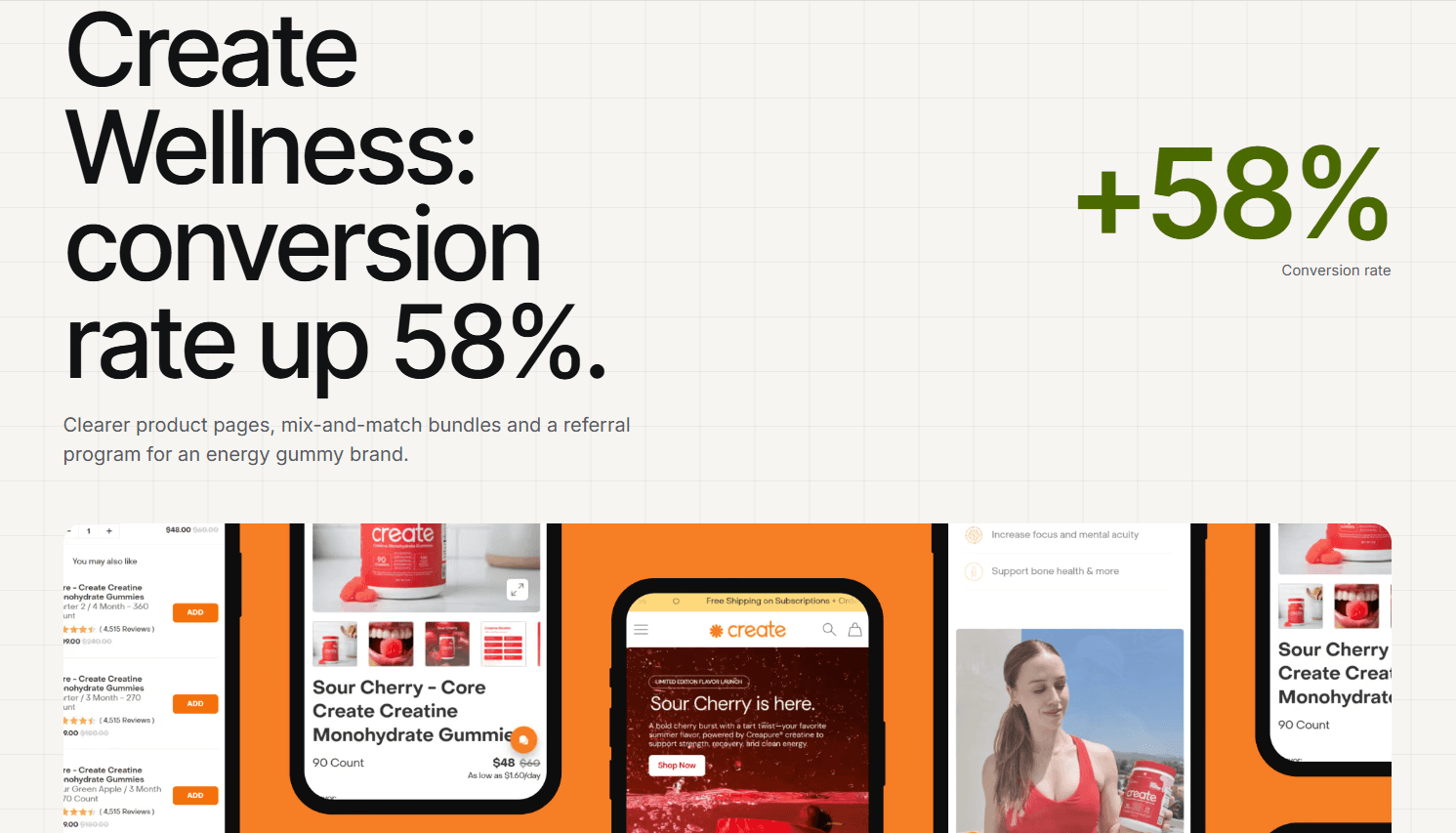
That result is not a subscription-churn benchmark, and it would be wrong to present it as one. The useful lesson is that retention starts before the cancellation page. The clearer the offer, the better the experience, and the easier the buying journey, the stronger the foundation for the customer relationship that follows.
For subscription brands, that means looking beyond the cancellation screen and asking where the customer experience starts breaking down.
What should you avoid when trying to reduce subscription churn?
A few mistakes come up repeatedly.
Discounting everyone.
You give away margin to customers who might have stayed without a discount.
Treating every cancellation reason the same.
Too much product, price, product dissatisfaction, and payment failure need different responses.
Ignoring involuntary churn.
A failed payment is not the same as a customer deciding to leave.
Making cancellation difficult.
A confusing cancellation experience may create short-term saves but damage trust.
Measuring only the immediate save rate.
A customer who accepts an offer and cancels one month later was not necessarily retained.
Ignoring the first few orders.
If customers never reach value, a cancellation offer is arriving too late.
Looking only at total churn.
Break the number down by reason, tenure, cohort, and churn type so you know what actually needs fixing.
How should you prioritize subscription retention work?
Use this order:
1. Recover failed payments.
These customers may not have intended to leave.
2. Improve onboarding and early customer experience.
Help customers reach value before the next renewal.
3. Add flexibility.
Give customers practical alternatives such as skip, pause, swap, and frequency changes.
4. Build targeted save offers.
Use discounts and incentives when the cancellation reason actually calls for them.
This keeps the team focused on the highest-value problems instead of starting with the most visible one.
How 100xretention approaches subscription retention
Reducing subscription churn is not just about building a better cancellation popup.
It requires looking at the customer journey, understanding where customers drop out, separating voluntary and involuntary churn, improving the experience, and building retention systems around real customer behavior.
That can include subscription optimization, loyalty, lifecycle messaging, segmentation, customer experience, and measurement.
The Subscriptions & Loyalty service focuses on building those systems around how customers actually buy and return.
Conclusion
The easiest churn tactic is usually a discount at cancellation.
The better approach is to fix the reason customers are leaving in the first place.
Recover failed payments. Improve the first few orders. Give customers control over their subscription. Then use targeted save offers when they actually make sense.
The goal is not to stop every cancellation. It is to keep the customers who still have a reason to stay.
If you want to find where your store is losing revenue across conversion, AOV, and retention, a free Revenue Audit can show you the three biggest leaks in a recorded walkthrough within 3 business days.
Frequently asked questions
What is a good churn rate for ecommerce subscriptions?
There is no single good number because it depends on your product, price, purchase frequency, and customer behavior. Compare your own churn by cohort, especially first-to-second order retention and later renewals. Public benchmarks can provide context, but your own trend is usually more useful for deciding what to fix.
How do you reduce involuntary churn?
Retry failed payments automatically where supported, notify customers clearly when a payment fails, and give them an easy way to update their payment method. Where available, use card-expiry reminders as well. Track payment recovery separately from voluntary churn so you can see whether the fix is working.
How do you reduce subscription churn on Shopify?
Work in order: recover failed payments, improve onboarding, add skip, pause and frequency options in the subscription experience, then use save offers based on cancellation reasons. Check what your subscription platform supports because features and workflows vary between apps.
Is skip or pause better than a discount?
It depends on why the customer is leaving. Skip or pause is better when the customer has too much product, is travelling, or needs a temporary break. A discount makes more sense when price is genuinely the problem. Ask for the cancellation reason and match the response to it.
How do you know if your save offers are working?
Track whether customers who accept a save offer remain active after their next renewal and again at 60 or 90 days when your volume allows. An immediate save rate only shows who accepted the offer. Longer-term retention shows whether the intervention actually changed the customer's decision.
Should every ecommerce brand offer subscriptions?
No. Subscriptions work best when customers naturally need to replenish a product on a recurring basis. If customers do not have a clear reason to reorder on a predictable schedule, forcing a subscription model can create unnecessary churn rather than improving retention.
When should you intervene before a customer cancels?
Look for signals such as repeated skips, longer gaps between orders, frequent delivery changes, product swaps, support issues, refunds, failed payments, or visits to the subscription management page. These behaviors can show that the customer is becoming less engaged before they formally cancel.
What should I fix first if my subscription churn is high?
Start by separating voluntary and involuntary churn. Then fix failed-payment recovery, examine early customer retention, improve subscription flexibility, and only after that optimize cancellation save offers. This prevents you from using discounts to solve problems that discounts cannot actually fix.