Ecommerce SMS Marketing: When It Works and When It Annoys

[ Summarize with AI ]
I have seen brands make the same mistake with ecommerce SMS marketing over and over.
They discover that a text message gets attention, so they send more of them. Then more promotions. Then another campaign because the last one generated revenue.
For a while, it works.
Then customers start unsubscribing.
That is the strange thing about ecommerce SMS marketing. The reason it works so well is also the reason it can become annoying so quickly. A text message gets attention precisely because it is harder to ignore than an email.
So the question is not whether SMS works.
It does. The real question is whether the message is worth interrupting someone for.
That comes down to four things: consent, relevance, timing, and frequency.
What is ecommerce SMS marketing?
Ecommerce SMS marketing is using text messages to communicate with customers about products, promotions, launches, replenishment, loyalty, and other relevant moments in the customer journey.
The important part is not the definition. It is the role SMS should play.
SMS is an immediacy channel.
If someone wants to know that a product is back in stock, that early access has opened, or that their welcome offer expires tonight, a text can be extremely useful.
If the customer needs a long product explanation, a collection guide, or a detailed brand story, email is usually the better tool.
That distinction prevents a lot of bad SMS marketing.
Why does SMS work for ecommerce?
Because people see it.
That sounds obvious, but it changes how the channel should be used.
An email can sit unopened for hours or days. A text is much more likely to be noticed quickly. That makes SMS particularly useful when timing is part of the value.
It also means mistakes are more expensive.
A boring email might be ignored. A boring text can feel intrusive.
Klaviyo's current guidance reflects this. It recommends getting explicit permission, clearly identifying the brand, keeping messages concise, using a clear CTA, and making it easy for subscribers to opt out.
A useful rule is:
Use SMS when immediacy adds value. Use email when depth adds value.
For example:
SMS: “The linen shirt you wanted is back in stock.”
Email: A full collection launch with product details, images, and styling ideas.
SMS: “Early access is live.”
Email: The full launch announcement.
The channels should complement each other, not compete to send the same message.
When does ecommerce SMS marketing work best?
The strongest SMS messages usually have one thing in common.
The customer has a reason to care right now.
That might be a product becoming available, a replenishment window approaching, or an offer that is genuinely relevant to the customer.
When the customer has already shown intent
Abandoned cart and checkout recovery are obvious examples.
Someone who added a product to their cart has already done more than simply browse. A well-timed SMS can bring them back.
But cart abandonment and checkout abandonment are not identical. The customer's level of intent is different, so the messaging does not necessarily need to be the same.
The distinction is covered in more detail in Cart Abandonment vs Checkout Abandonment.
When something the customer wants becomes available
Back-in-stock SMS is one of the easiest use cases to justify.
The customer already told the brand they wanted the product. The message simply tells them it is available again.
That is very different from interrupting someone with a random promotion.
When a product naturally needs replenishment
Replenishment is another strong use case, particularly for consumable products.
If a customer typically runs through a product in 30 to 45 days, a well-timed reminder can be useful.
It does not need to come with a discount.
The timing itself is the value.
When a launch actually benefits from immediacy
SMS can work well for launches, especially when subscribers receive early access.
“You're in early. The new collection is live: [link]”
There is a reason to open the message. There is a reason to click it.
That is what a good SMS campaign should do.
When a customer is worth winning back
Win-back SMS can be useful, but not every inactive customer deserves the same treatment.
Someone who purchased three times and normally buys every month is very different from someone who made one purchase 18 months ago.
Use purchase history, recency, product category, and engagement to decide who should receive a win-back message.
A good Klaviyo win-back flow should reflect those differences.
When does SMS marketing start annoying customers?
Usually when the brand starts confusing access to the customer's phone with permission to use it constantly.
The warning signs are predictable:
- Too many promotional messages
- The same offer repeated across email and SMS
- Generic messages sent to everyone
- No real reason to act now
- Long texts that belong in email
- Poor sending times
- Discounts becoming the only reason to communicate
- Continuing to message customers who clearly stopped engaging
There is a simple test I use:
If this message came from a brand I did not particularly care about, would I be glad I received it?
If the answer is no, the message probably needs work.
How should an ecommerce brand grow its SMS list?
Start with the value exchange.
Do not ask someone for a phone number simply because the brand wants another marketing channel.
Give them a reason to subscribe.
That could be:
- Early access
- Restock alerts
- Product launches
- VIP access
- Replenishment reminders
- A first-order incentive
- Useful customer updates
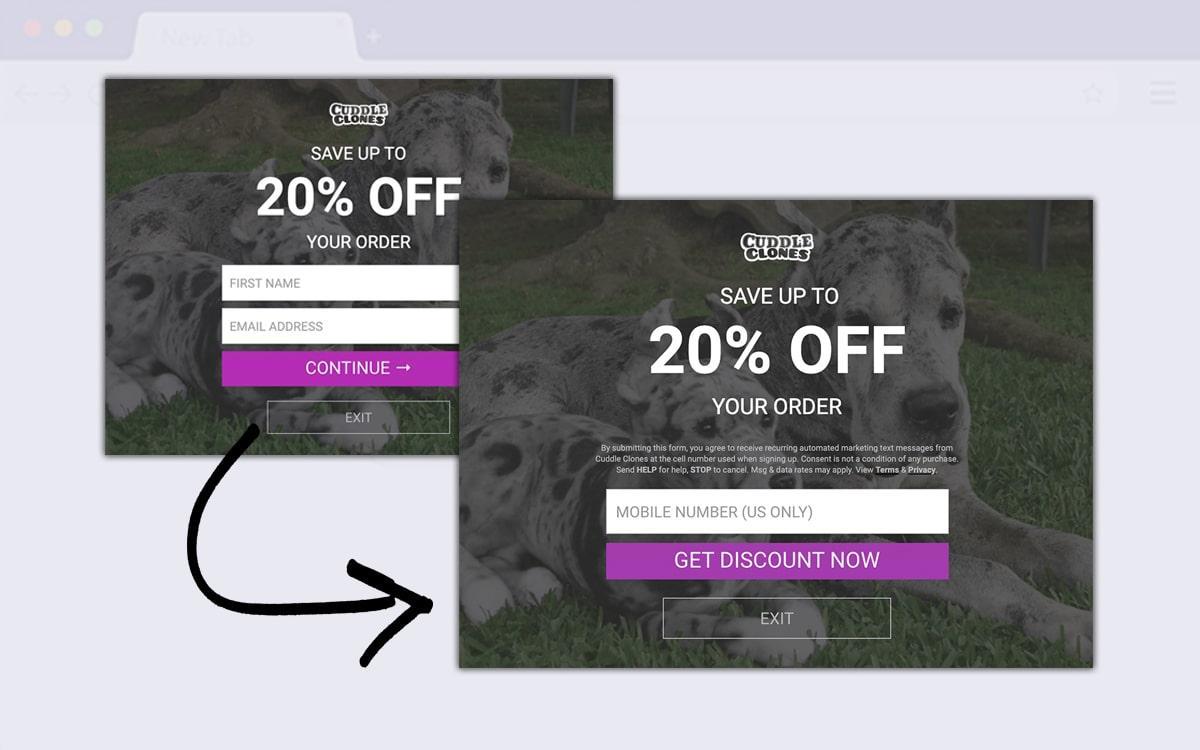
The consent itself also needs to be clear.
Email consent does not automatically mean SMS marketing consent. Klaviyo specifically states that having someone's phone number is not sufficient permission to send marketing SMS.
The signup experience should make it clear what the customer is agreeing to receive.
Should email and SMS be collected together?
They can be offered together, but they should not be treated as the same permission.
A customer may want email but not SMS.
Another customer may want SMS for launches and offers but ignore most emails.
Let the customer choose where possible.
That usually creates a better list than trying to maximize the number of phone numbers collected.
What types of SMS messages work best for ecommerce?
There is no single “best” SMS.
The best message is the one that makes sense for that customer at that moment.
Welcome SMS
Keep it simple.
“Welcome to [Brand]. Your 15% off is ready: [link]”
The first text does not need to tell the entire brand story.
Abandoned cart SMS
Cart recovery works because the customer has already shown buying intent.
The important part is making sure the customer has properly opted in and that the flow follows the applicable requirements.
For US abandoned-cart SMS, Klaviyo currently recommends double opt-in, limiting the flow to one SMS per recipient, and sending it within 48 hours.
Back-in-stock SMS
This is probably one of the cleanest SMS use cases.
The customer asked for the notification.
The brand delivers it.
No clever copy is necessary.
Product launch SMS
Launch messages work best when the SMS subscriber gets something meaningful that other customers do not.
Early access is a good example.
“[Brand]: Early access is live. Shop the new collection: [link]”
Replenishment SMS
The best replenishment message is often the least promotional.
“Running low? Your usual [product] may be due for a refill: [link]”
The customer does not necessarily need a discount. They need the reminder at the right time.
Win-back SMS
Win-back should be based on customer behavior.
A high-value customer who has suddenly stopped purchasing may deserve a different message from a one-time buyer.
This is where segmentation becomes more important than copywriting.
VIP and loyalty SMS
SMS can give high-value customers access to things they genuinely care about:
- Early access
- Limited releases
- VIP offers
- Loyalty milestones
- Special events
The goal is not to make VIP customers receive more messages.
It is to make the messages they receive more valuable.
How often should ecommerce brands send SMS?
There is no magic number.
Klaviyo currently suggests roughly 2 to 6 SMS messages per month as a starting point, then recommends adjusting based on engagement and customer expectations.
Treat that as a starting point, not a rule.
A consumables brand may have more legitimate reasons to contact customers than a premium brand selling expensive products a few times a year.
The bigger mistake is looking only at campaign frequency.
A customer might receive:
- A welcome SMS
- An abandoned-cart SMS
- A promotional campaign
- A replenishment reminder
All from different parts of the marketing program.
The customer does not care that those messages came from four different flows.
They just know the brand keeps texting them.
Frequency needs to be managed across the entire lifecycle.
What time should ecommerce SMS be sent?
Respect the customer's local time.
Klaviyo recommends avoiding marketing SMS before 9 a.m. or after 8 p.m. in the recipient's local time as a conservative best practice.
This matters for brands selling across the US.
A campaign that looks perfectly timed in New York can arrive far too early for someone on the West Coast if local time is not handled correctly.
Timing is not a small detail with SMS.
It is part of the experience.
What should an ecommerce SMS message look like?
Short.
A useful structure is:
Brand + reason to care + action + link
For example:
“[Brand]: Your favorite cleanser is back in stock. Shop now: [link]”
Or:
“[Brand]: Early access starts now. Shop before everyone else: [link]”
Or:
“[Brand]: Your 15% welcome offer expires tonight: [link]”
One message.
One idea.
One CTA.
Klaviyo's SMS guidance similarly recommends concise messages and clear calls to action.
If the message needs three paragraphs to explain itself, it probably belongs in an email.
SMS vs email. Which is better for ecommerce?
Neither.
They do different jobs.
Email is better for depth. SMS is better for immediacy.
Email gives the brand room for product education, comparisons, storytelling, editorial content, and detailed promotions.
SMS is better when the customer needs a short message and a quick action.
For example:
SMS: “Early access is live.”
Email: The full launch story, product details, images, and recommendations.
The biggest mistake is sending the same campaign through both channels at the same time simply because both channels are available.
The customer does not need the same message twice.
How should ecommerce brands segment SMS subscribers?
Do not send every SMS to the entire list.
At a minimum, consider:
- New subscribers
- Recent purchasers
- Highly engaged subscribers
- High-value customers
- Customers interested in specific products
- Customers approaching replenishment
- Customers showing signs of churn
Klaviyo's SMS guidance also recommends using behavioral and engagement-based segments rather than treating the entire SMS list as one audience.
The important question is not how many segments a brand has.
It is whether segmentation changes the message.
If two segments receive exactly the same SMS, there may be no reason to keep them separate.
A strong Klaviyo segmentation strategy should make communication more relevant, not simply more complicated.
What does SMS compliance involve in the US?
This is not an area to guess.
Marketing SMS generally requires appropriate consent, clear identification, opt-out mechanisms, and compliance with applicable federal, state, carrier, and platform requirements.
Email opt-in alone is not enough.
Klaviyo's current guidance emphasizes explicit permission, brand identification, easy unsubscribe, and appropriate sending practices.
There are also specific requirements around automated messages. For example, Klaviyo's guidance for US abandoned-cart SMS includes double opt-in and limits around the number and timing of messages.
The exact legal requirements can vary depending on how consent is collected, what is being sent, and who is receiving the message.
For that reason, platform guidance is useful for implementation, but it should not replace legal advice.
How do you know if ecommerce SMS marketing is working?
Revenue is the obvious metric.
It is not the only one.
Look at:
- Delivery rate
- Click rate
- Conversion rate
- Revenue per recipient
- Unsubscribe rate
- Revenue by campaign
- Revenue by flow
- Repeat purchase rate
- Incremental revenue
The last one is especially important.
If an SMS gets attributed revenue because someone clicked and purchased five minutes later, that does not automatically mean the SMS created the entire purchase.
The better question is:
Would that customer have purchased anyway?
Where possible, use holdouts or controlled tests to understand incrementality instead of relying entirely on platform attribution.
For larger retention programs, Analytics & Measurement can help connect SMS performance to the broader customer journey rather than treating attributed SMS revenue as the entire story.
What does good SMS retention actually look like?
It does not look like more texts.
It looks like better timing.
Think about the customer journey:
Subscribe → First purchase → Product use → Replenishment → Second purchase → Loyalty → Win-back
SMS can support several of those moments.
It does not need to own all of them.
That distinction matters because a retention program can easily become over-automated. Every possible customer event becomes another message, and eventually the brand is optimizing for message volume instead of customer value.
The goal is not maximum SMS revenue.
The goal is more profitable customer revenue without damaging the relationship.
That is also why SMS should be considered alongside email, retention strategy, CRO, and the post-purchase experience.
For example, at Create Wellness, 100xretention improved the customer experience and conversion performance, resulting in a 58% increase in conversion rate. The lesson applies beyond CRO. Retention channels perform better when they are connected to a strong overall customer experience.
What are the most common ecommerce SMS mistakes?
The biggest mistakes are not complicated.
Sending too often
More messages do not automatically mean more revenue.
Repeating the same promotion
If the customer receives the same offer by email, SMS, and another channel, the experience quickly becomes repetitive.
Treating every subscriber the same
A new subscriber, VIP customer, recent purchaser, and inactive customer have different needs.
Making discounts the only reason to communicate
If every SMS says “20% off,” customers learn to wait for the next discount.
Ignoring what happens after the click
SMS cannot fix a poor product page, confusing checkout, or weak offer.
If the message gets the customer back but the experience loses the sale, the SMS was not the real problem.
Measuring attributed revenue without testing incrementality
Attribution tells you what the platform credits to SMS.
It does not automatically tell you what would have happened without it.
How 100xretention approaches ecommerce SMS marketing
The starting question should not be:
“How many SMS campaigns should this brand send?”
It should be:
“Where can SMS genuinely improve the customer journey?”
That means looking at customer behavior, lifecycle stages, existing email flows, purchase frequency, segmentation, and the points where customers are dropping out.
Then SMS can sit alongside Klaviyo email and SMS marketing as part of a broader retention system.
The objective is not to make SMS louder.
It is to make it more useful.
Conclusion
Ecommerce SMS marketing works when the customer has a reason to want the message.
The best programs are selective. They use SMS for immediacy, email for depth, segmentation for relevance, and testing to determine whether the channel is actually creating incremental revenue.
The moment every text becomes another promotion, the advantage disappears.
If you want to find the biggest opportunities across conversion, AOV, and retention, start with the 100xretention Revenue Audit.
Frequently asked questions
Is ecommerce SMS marketing still effective?
Yes. SMS can still be an effective ecommerce retention channel when subscribers receive relevant, timely messages. Its strength is immediacy, not volume. Brands generally get more value from using SMS selectively for high-intent and time-sensitive moments.
How often should an ecommerce brand send SMS?
There is no universal frequency. A practical starting point is around 2 to 6 messages per month, then adjust based on engagement, unsubscribe behavior, customer expectations, and the automated messages customers already receive.
What is the best SMS message for ecommerce?
There is no single best message. Back-in-stock alerts, product launches, abandoned-cart messages, replenishment reminders, VIP access, and targeted win-back messages can all work because they are connected to a specific customer need or behavior.
Should ecommerce brands use SMS for every promotion?
No. SMS works best when the message has a clear reason to interrupt the customer. Sending every promotion through SMS can increase fatigue and unsubscribes. Promotional SMS should earn its place by offering something relevant, timely, exclusive, or genuinely useful.
Is SMS better than email for ecommerce?
Neither is simply better. SMS is usually better for short, immediate communication. Email is better when customers need more context, product information, education, or storytelling. The strongest retention programs use both channels for different jobs.
How do you grow an ecommerce SMS list?
Give customers a clear reason to subscribe, such as early access, product alerts, replenishment reminders, or a first-order incentive. SMS consent should be explicit and separate from email consent so customers understand what they are agreeing to receive.
Is SMS marketing legal for ecommerce brands in the US?
Ecommerce brands need to follow applicable SMS marketing and privacy requirements, including appropriate consent and opt-out mechanisms. Requirements can vary by situation and jurisdiction, so brands should follow current provider guidance and obtain appropriate legal advice rather than assuming email consent is sufficient.