Email Marketing vs SMS for DTC: What to Invest in First

[ Summarize with AI ]
If you added SMS before your email flows were finished, you are probably paying per text to do work email could do for almost nothing. The short answer to email marketing vs SMS for DTC: build email first, then add SMS only where speed is worth paying for.
This guide gives you the math to decide for your own brand: what each channel costs per subscriber, how to find SMS break-even on contribution margin, and a 90-day plan for adding texts without cannibalizing email.
Want to know which channel is losing you money? Get a free revenue audit.
Email Marketing vs SMS for DTC: Which Comes First?
For most DTC brands, email comes first and SMS comes second. Email is cheaper per send, holds more content, and builds the core lifecycle flows that drive repeat revenue. SMS works best as a smaller, high-intent layer on top of a working email program, used for moments where speed matters.
Email marketing has near-zero marginal cost once you pay for the platform. Every flow you build keeps earning on every new subscriber. SMS marketing charges you for each message segment, so it only pays when each text drives enough profit to cover its cost.
There are exceptions, covered later. Drop-based brands, replenishment products and very mobile-heavy audiences can justify SMS earlier. But the default order for a Shopify or DTC brand is email, then SMS.
Email Marketing vs SMS for DTC: Side-by-Side Comparison
Email is the system. SMS is the alert. Email carries education, stories, product detail and long flows. SMS carries short, urgent messages that need a fast response.
Factor | Email marketing | SMS marketing |
Cost per send | Very low, usually included in your platform plan up to a send limit | Paid per message segment, including carrier fees |
Message length | Unlimited, with images, layout and long copy | 160 characters in a single text (70 with emoji). Longer texts split into 153-character segments (67 with emoji) |
Speed of engagement | Opened over hours or days | Usually read within minutes |
Consent | Opt-in plus CAN-SPAM rules in the US | Separate, explicit written consent under the TCPA |
Opt-in rate | Higher, easier ask with a popup | Lower, people guard their phone number |
Best jobs | Welcome series, education, browse and cart recovery, post-purchase, winback, newsletters | Abandoned checkout nudges, flash sales, product drops, restock alerts, shipping updates |
Fatigue risk | Moderate, unsubscribes and spam filtering | High, every text is an interruption |
Ownership | Owned list, portable across platforms | Owned list, but tied to strict consent records |
One caution on benchmarks. You will see claims like "SMS has a 98% open rate" everywhere, often with no source. Most SMS platforms cannot track opens the way email tools do, so clicks and conversions are the fairer measure. Judge both channels on revenue per recipient and profit, not on open rates.
Email vs SMS marketing in plain terms
Think of email as the place customers learn about you. A good email marketing program for ecommerce explains why your product works, shows reviews, teaches customers how to use it, and reminds them to reorder.
SMS is where you tap them on the shoulder. A restock of the size they wanted. A cart that expires tonight. An order that just shipped. These are the moments where ecommerce SMS marketing earns its cost. If the message would not make sense as a short text from a friend, it probably belongs in email.
What Email and SMS Really Cost a Shopify Brand
Email costs a flat monthly platform fee that rises with list size, so each extra send is close to free. SMS bills every message segment to every recipient, carrier fees included. At an example rate of $0.015 per segment, four 1.5-segment texts a month cost about $1.08 per subscriber per year, before discounts.
On Klaviyo, the email side is priced by the number of profiles. The free plan covers 250 profiles and 500 emails a month, and paid email plans start at $20 a month for 500 profiles. Once you pay the plan, sending one more email costs you almost nothing.
SMS works the other way. Each text is billed per segment, per recipient, and the rate includes carrier fees. This is where costs creep in without anyone noticing:
- Long texts. Anything over 160 characters splits into segments of 153 characters each, so a 300-character text bills as two segments.
- Emoji. One emoji drops the limit to 70 characters, or 67 per segment once a text splits.
- Images. MMS messages cost more than plain SMS. On Klaviyo's older credit system, one MMS used three credits against one for an SMS.
- Failed deliveries. Klaviyo bills these too. Confirmations and STOP or HELP replies are free.
- Discounts. The code in the text is a cost on every order it touches, including orders that would have happened anyway.
A simple way to compare the two is cost per subscriber per year.
Email cost per subscriber = Monthly plan cost × 12 ÷ Profiles on the list
SMS cost per subscriber = Texts per month × Segments per text × Rate per segment × 12
Say you send four texts a month, each averaging 1.5 segments, at an example rate of $0.015. That is about $1.08 per SMS subscriber per year, before discounts. For a 20,000-person SMS list, that is roughly $21,600 a year. The email cost for the same people is usually a small fraction of that. Neither number is good or bad on its own. What matters is whether the profit from those texts beats the cost.
Email has its own upkeep, though. Gmail now requires authenticated sending domains and easy one-click unsubscribes, and it filters brands with high spam complaints. Keep your list clean and email stays cheap. Ignore it, and inbox placement drops, which makes email far less valuable than any benchmark suggests.
SMS vs Email ROI: How to Do the Math for Your Brand
SMS vs email ROI comes down to cost per send against profit per send. Email usually wins on ROI because its cost per message is close to zero. SMS can still win on profit per message for urgent, high-intent moments, but only if you measure it on contribution margin, not attributed revenue.
The ROI figures you see online for email, often quoted as dozens of dollars back for every dollar spent, come from broad surveys and vendor reports. They vary by industry, list quality and attribution window. Use them as context, not as a target. Your own math is what matters.
Start with this formula for any SMS campaign or flow:
Campaign cost = Recipients × Segments per message × Cost per segment
Break-even revenue = Campaign cost ÷ Contribution margin %
Contribution margin = Price − Product costs − Fulfillment − Payment fees − Discount
Contribution margin % = Contribution margin ÷ Price
Check your real rate in Klaviyo under Settings, then Billing.
Here is how that plays out. A two-segment text to 10,000 subscribers at an example rate of $0.015 per segment costs $300. At a 40% contribution margin, it needs $750 in revenue to break even. Not attributed revenue, but truly incremental revenue. That gap is where most SMS programs get flattered.
Why attributed revenue overstates SMS
Klaviyo's default attribution credits SMS for orders placed within a short window after a click or delivery. If someone was already going to buy from your email, and they also got a text, the text may take the credit. Both channels can claim the same order.
The fix is a holdout group. Send the SMS campaign to 90% of the eligible audience and hold back 10%. Compare revenue per recipient between the two groups. If the held-back group buys almost as much, the SMS was mostly taking credit, not creating sales. This is basic A/B testing logic applied to retention, and it is the single best habit for keeping SMS honest.
Why Email Should Usually Come First for DTC Brands
Email should come first because its flows earn on every future subscriber at almost no extra cost. A strong welcome series, abandoned checkout flow and post-purchase flow keep working for years once they are built and tested.
There are four practical reasons.
- Bigger list, faster. Most shoppers will give an email address for a first-order offer. Far fewer will give a phone number. Your email list will almost always be several times larger than your SMS list.
- Room to sell. Email can carry reviews, ingredient or material detail, comparison charts, bundles and how-to content. That is where you build trust and raise AOV, which a short text cannot do.
- Flows compound. Each flow you add, from browse abandonment to winback, raises the revenue per subscriber across the whole list. See the complete list of Klaviyo flows every Shopify brand needs for the build order.
- Mistakes are cheap. A weak email costs you an unsubscribe or two. A weak text costs you money per send and often a permanent opt-out.
A real example shows how far email alone can carry a brand. Andrea Maack, a luxury fragrance house, had thin email flows and repeat purchases left to chance. The work combined a mobile-first redesign, a product finder quiz, a bundle builder and a rebuilt Klaviyo program: abandoned cart and checkout, browse abandonment, winback, thank-you and a new welcome series. Total revenue grew 85%, and email reached a 31.76% share of revenue.
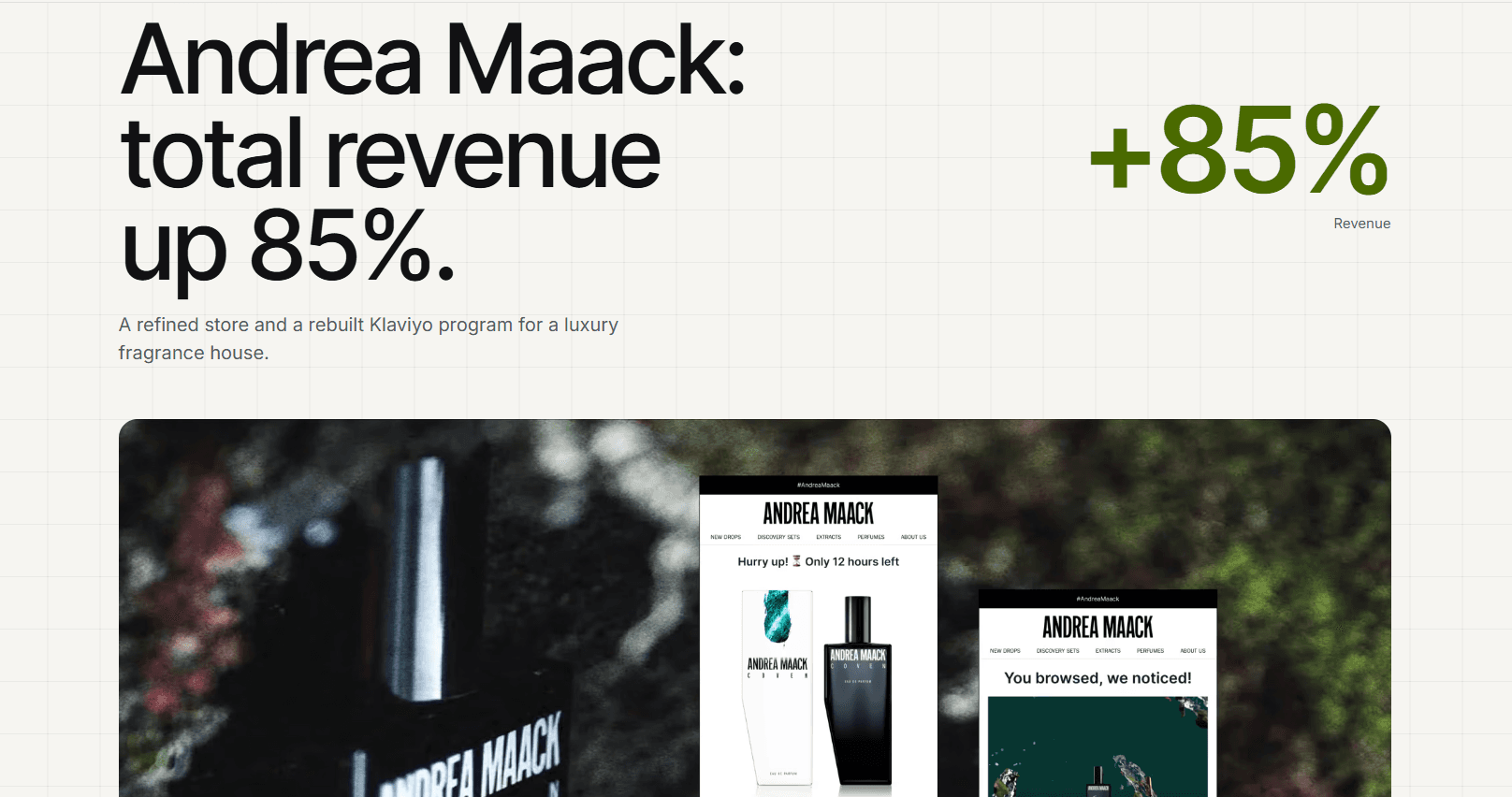
None of that work used SMS. The program was built on email flows, and email reached almost a third of revenue alongside the site changes.
When SMS Should Come First (or Very Early)
Add SMS early when a late message loses the sale. That means limited drops that sell out in hours, replenishment products with a predictable reorder date, or high-margin orders where one recovered checkout pays for thousands of texts. If none of those fit your brand, finish your core email flows first and collect SMS consent in the meantime.
Add SMS early if your brand fits one or more of these:
- Drop or limited-release model. Apparel drops, collectibles and limited runs sell out in hours. A text at launch time is worth more than an email read the next morning.
- Replenishment products. Supplements, coffee, pet food and skincare have a predictable reorder window. A short "running low?" text with a one-tap reorder link fits perfectly.
- Very mobile-heavy traffic with low email engagement. If your Shopify Analytics show most sessions on mobile and your email click rates are weak even after list cleaning, SMS can reach people email does not.
- High AOV with healthy margin. When each order is worth $150 or more in contribution, the per-message cost barely matters.
Even then, build the core email flows in parallel. SMS without email means you have no place to tell the longer story.
How your product category changes the answer
What you sell changes the timing. Replenishment and drop brands, covered above, can start SMS early. Home goods and high-ticket products are bought after research, so email carries the load for longer, and SMS is mostly shipping and delivery updates.
The rule of thumb: the more your sales depend on timing and repeat purchase, the earlier SMS pays. The more they depend on research and trust, the longer email works alone.
Are you ready for SMS? A quick checklist
If you can tick most of these, adding SMS is likely to pay off:
- Welcome, abandoned checkout, abandoned cart and post-purchase emails are live and have been tested
- You know your contribution margin per order, not just revenue
- You have at least one moment where speed matters: drops, restocks, replenishment or shipping
- Your popup or checkout already collects SMS consent separately from email
- You can run a holdout test and read the results
- Someone owns SMS frequency so texts do not go out every time an email does
Not sure when to add SMS? Book a call with the 100xRetention team.
Klaviyo Email vs SMS: How to Run Both Without Cannibalizing
In Klaviyo, email and SMS work best inside the same flows, with SMS sent only to people email did not convert. One platform, one customer profile, and clear rules on which channel speaks first.
Running both channels in Klaviyo has a real advantage over separate tools. Both use the same profile, the same events from Shopify, and the same segments. That lets you build logic like "send the text only if the email was not clicked" instead of blasting both at once.
A simple rule set that works for most brands:
Flow | Email role | SMS role |
Welcome series | Lead channel: brand story, best sellers, first-order offer | One text after opt-in confirming the offer, nothing more |
Abandoned checkout | First message within about an hour | One text later, only if the email was not clicked and no order was placed |
Browse and cart abandonment | Lead channel | Usually skip. Intent is too low to justify the cost |
Post-purchase | Education, how-to, review request, cross-sell | Shipping and delivery updates |
Replenishment | Reminder with product detail | Short reorder nudge near the expected run-out date |
Winback | Lead channel with a stronger offer | Final text to high-value lapsed customers only |
Campaigns | Most launches, stories and promos | Drops, flash sales and last-call moments only |
Two settings matter more than people think. First, use Klaviyo's smart sending and flow filters so one person does not get an email and a text for the same thing within minutes. Second, segment SMS by value and engagement. Your SMS list should not get every campaign your email list gets. The Klaviyo segmentation guide covers the segments that make this work.
If you want this built and tested properly, that is exactly what Klaviyo email and SMS marketing at 100xRetention covers, from flow architecture to channel rules and holdout testing.
Using Klaviyo predictive analytics to decide who gets texts
Klaviyo's predictive analytics add two profile fields that make SMS cheaper to run well. Expected date of next order tells you when a replenishment customer is likely to reorder, so the reorder text goes out near that date instead of on a fixed schedule. Predicted customer lifetime value lets you build an SMS segment of your most valuable customers, so campaign texts go to the people most likely to cover their cost. Klaviyo only calculates these fields once an account has enough order history, so check that they appear on your profiles first. Smaller accounts can get a similar result with a simple RFM segment (recency, frequency and monetary value) built from Shopify order data.
Klaviyo SMS or a dedicated SMS tool?
This comes up often in the Shopify Community. Klaviyo keeps email and SMS on one customer profile, so it is easy to stop a text when the email already converted, and you get one view of each customer's revenue. Dedicated SMS tools like Postscript or Attentive often go deeper on two-way messaging and SMS-specific compliance features. The cost is running two systems that can both message the same shopper and both claim the same sale.
For most $1M to $20M brands, one platform is the cleaner choice. The main benefit is being able to stop two tools from messaging the same person about the same cart.
How to Grow an SMS List Without Hurting Email Signups
Grow your SMS list by asking for email first and phone number second. Use a two-step popup, an unchecked SMS box at Shopify checkout, a shipping-updates opt-in on the thank-you page, and back-in-stock forms. Each one captures phone numbers from shoppers who are already engaged, without adding friction to your main email signup.
These are the opt-in points that tend to work best for DTC brands:
- Two-step popup. Step one asks for email in exchange for the first-order offer. Step two asks for a phone number for a small extra perk, like early access or free shipping. People who skip step two still give you their email.
- Shopify checkout. Turn on the SMS marketing checkbox at checkout. Keep it unchecked by default, because consent must be the shopper's choice.
- Thank-you page. Offer shipping updates by text right after the order. Buyers want to know where their package is, which makes this one of the easiest asks. The thank-you page optimization guide covers what else belongs on that page.
- Back-in-stock and waitlist forms. Shoppers asking to be told when a product returns are often happy to get that alert by text.
- Keyword opt-in. "Text GLOW to 12345" works on packaging inserts, social posts and live events.
Whatever the entry point, the disclosure next to the form must say what they will get, how often, that message and data rates may apply, and how to opt out.
What good DTC texts look like
Good texts are short, name the brand, give one reason to act, and carry one link. Here are three examples for a fictional brand, each under 160 characters so it bills as a single segment:
- Abandoned checkout (122 characters): Glow Co: Your cart is saved, but your size is low in stock. Finish checkout here: glowco.test/c/8Kd2 Reply STOP to opt out
- Restock alert (124 characters): Glow Co: The Rose Serum is back in stock. Last restock sold out in 2 days. Shop now: glowco.test/r/rs1 Reply STOP to opt out
- Replenishment (137 characters): Glow Co: Running low on Daily Greens? Your 30-day supply runs out this week. Reorder in one tap: glowco.test/o/dg30 Reply STOP to opt out
Notice what is missing. No discount, no emoji and no second link. Each one gives a real reason to act now, which is the whole point of the channel.
A 90-Day Plan for Email Marketing vs SMS for DTC
Build email flows in month one, test and grow them in month two, and add SMS to two or three high-intent moments in month three. This order gets revenue flowing early and keeps SMS cost tied to proven demand.
- Days 1 to 30: Build the email base. Set up the welcome series, abandoned checkout, abandoned cart, browse abandonment and post-purchase flows. Add an email capture popup with a clear first-order offer. Collect SMS consent in the same popup as a second, optional step, so the SMS list starts growing before you send a single text.
- Days 31 to 60: Test and fix email. A/B test subject lines, offer types and send timing in the welcome and checkout flows. Clean unengaged profiles to protect deliverability. Add winback and replenishment flows. The Klaviyo abandoned cart flow guide has timing and template detail.
- Days 61 to 90: Add SMS where speed pays. Turn on SMS for abandoned checkout, shipping updates and one campaign type, such as drops or restocks. Run each with a holdout group. Keep only the SMS messages that show incremental profit.
- After day 90: Scale what proves out. Expand SMS to replenishment and winback for high-value segments. Review revenue per recipient, unsubscribe rate and opt-out rate by channel every month.
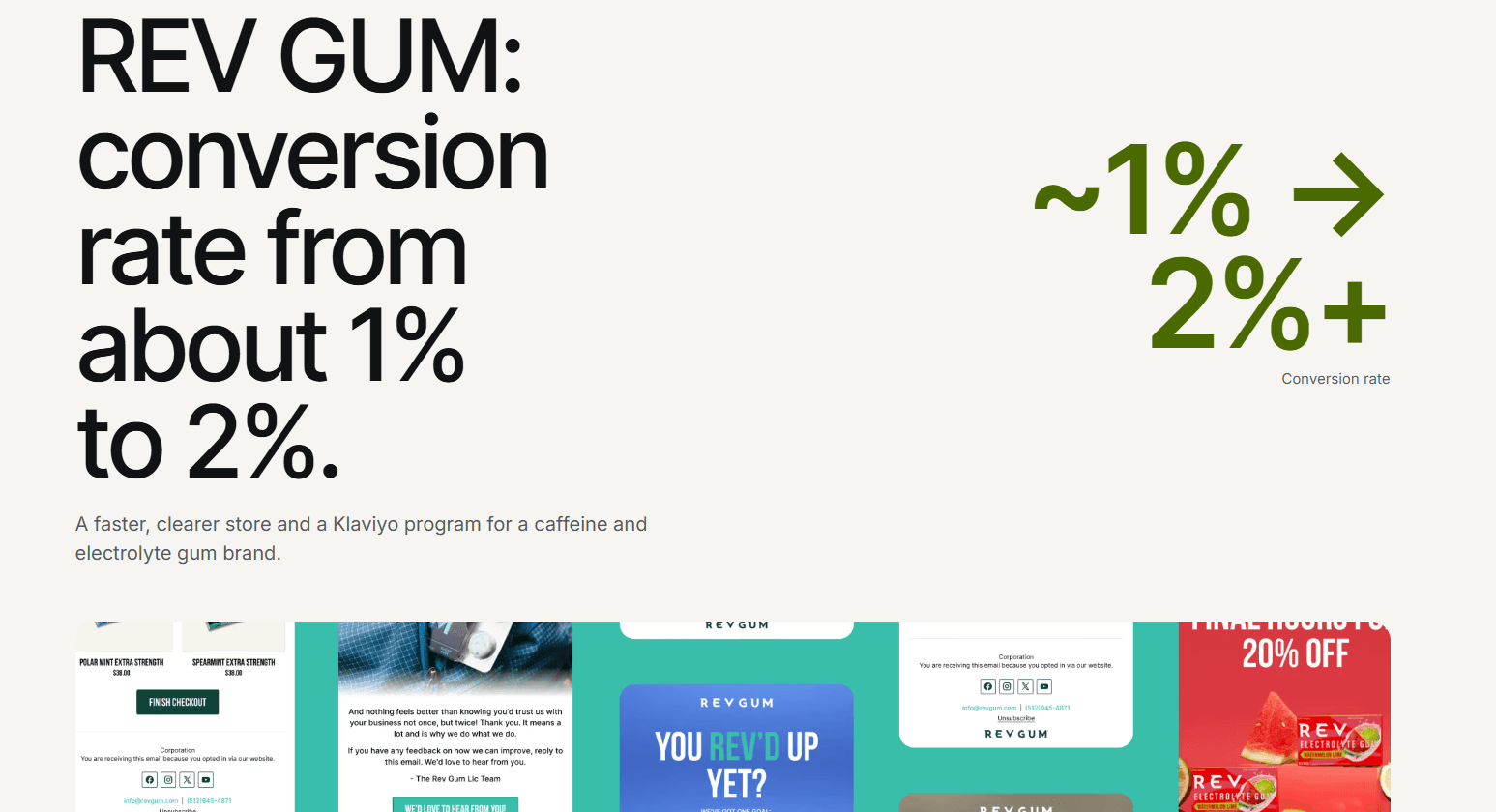
REV GUM shows what the first two months of this plan can do. The Klaviyo work started with email: abandoned cart and checkout, a new welcome series, winback, and post-purchase and education campaigns, alongside rebuilt landing and product pages. Klaviyo revenue grew 243% against the previous period and reached 19.26% of sales.
How to split your budget between email and SMS
There is no correct percentage, but your revenue stage gives a sensible starting point. Under $1M, put nearly all your effort into email flows and simply collect SMS consent. From $1M to $5M, add SMS for abandoned checkout, shipping updates and one campaign type. Past $5M, SMS can take on replenishment, VIP early access and drops, each with its own holdout. At every stage, SMS grows only as fast as it proves profit.
Which Metrics to Track for Email vs SMS Marketing
Track revenue per recipient and incremental profit for both channels. Do not compare open rates. Email opens are inflated by privacy features, and SMS opens are not tracked at all.
For each channel, watch revenue per recipient, click rate, placed order rate and opt-out rate, and use holdouts to see the real lift. If texts or emails get clicks but few orders, the problem may not be the channel at all. It may be the landing page, product page or checkout. That is where Shopify CRO work and channel work meet.
SMS Compliance Basics for US DTC Brands
US marketing texts need prior express written consent under the TCPA, a clear opt-out, and brand identification in the message. Email consent does not cover SMS. They are separate permissions.
This is not legal advice, but every brand should know the basics:
- Separate, optional consent. The SMS opt-in must be its own checkbox or step, and it cannot be required to buy. Klaviyo requires consent for all SMS, including transactional texts.
- Clear disclosure. Say what they will receive, roughly how often, that message and data rates may apply, and how to opt out.
- Opt-out that works. Honor STOP and similar replies immediately. Recent FCC rules also require honoring opt-out requests made in other reasonable ways.
- Sending hours. Federal rules restrict telemarketing before 8 a.m. and after 9 p.m. in the recipient's local time, and some states, such as Florida, are stricter. Use quiet hours in Klaviyo.
- Registered numbers. US carriers require registered sending numbers (10DLC or verified toll-free). Klaviyo walks you through this during SMS setup.
TCPA penalties run $500 to $1,500 per violation under the statute, which is why class actions target texting brands. Get consent language reviewed before you launch.
Common Email and SMS Mistakes
The most common mistake is treating SMS as a second email channel. Sending the same campaigns to both lists doubles cost and fatigue without doubling revenue.
- Launching SMS before email flows work. You pay per message to fix gaps that email would cover almost for free.
- Judging SMS on attributed revenue. Without holdouts, SMS takes credit for orders email already drove.
- Discounting in every text. It trains customers to wait for a code and erodes margin on full-price buyers.
- Same cadence on both channels. Texts should be far less frequent than emails. Watch opt-out rates closely after every SMS campaign.
- Ignoring segment length. Emoji and long links quietly double or triple cost.
- No post-purchase plan. Both channels focus on the first sale while repeat purchase is left to chance. The post-purchase experience guide covers what to send after the order.
The 100xRetention Approach to Email and SMS
The 100xRetention approach treats email and SMS as one retention system, judged on profit per customer, not channel vanity metrics. It follows four steps.
- Audit. The analysis starts with flow coverage, revenue per recipient by flow, list health and attribution settings in Klaviyo, plus Shopify Analytics data on mobile share, repeat rate and time between orders. This shows which moments are missing and which channel fits each one.
- Prioritize. Gaps are ranked by revenue impact and effort. Usually that means fixing the welcome and checkout flows first, then deciding which two or three moments justify SMS based on margin and urgency.
- Test. Every SMS addition runs against a holdout, and email flows are A/B tested on offer, timing and content. Only changes that prove incremental profit stay live.
- Compound. Winning flows feed into retention marketing work like replenishment, winback and loyalty, so each new customer is worth more over time. That ties channel decisions back to lifetime value, not one campaign's results.
Conclusion
Email marketing vs SMS for DTC is not really a choice between two channels. It is a question of order. Build email first, because it is cheap, holds your full story and keeps earning through flows. Then add SMS for a few urgent moments, like checkout recovery, drops and restocks, and test each one against a holdout group.
Want to see where your email and SMS program is losing money? Get a free revenue audit.
Frequently asked questions
How big should my email list be before I add SMS?
There is no fixed number. A better test is whether your core email flows are built and tested, and whether you have urgent moments like drops, restocks or replenishment. Start collecting SMS consent early so the list exists when you are ready to send.
How much does SMS marketing cost on Klaviyo?
Klaviyo charges per message segment, and the rate includes carrier fees. Your exact rate shows in Settings, then Billing, and varies by account and by SMS or MMS. Opt-in confirmations and STOP or HELP replies are not billed, but failed deliveries are.
Should I use Klaviyo for SMS or a separate tool like Postscript or Attentive?
If email already runs in Klaviyo, keeping SMS there is simpler. One profile and one set of flows makes channel rules and suppression easy. Dedicated SMS tools can make sense for brands where SMS is a major channel and needs features like advanced two-way messaging.
How often should a DTC brand send marketing texts?
Far less often than email. A sensible starting point is a few campaign texts a month plus flow messages, then adjust from your own data. Watch your opt-out rate after each send and pull back when it rises.
Can I text customers who gave their phone number at Shopify checkout?
Not for marketing unless they also gave SMS marketing consent. A phone number collected for shipping is not permission to send promotions. Use a separate, clearly worded SMS opt-in.
Is SMS worth it for a small Shopify store?
It can be, but usually after email. A small store gets more from a working welcome series and abandoned checkout flow than from paid texts. Add SMS when a specific moment, such as a restock, clearly needs speed.
Is SMS better than email for abandoned cart recovery?
SMS often shows higher recovery rates in merchant reports, but much of that can be credit taken from email. The strongest setup uses both: email first with the cart details, then one text later only if the email did not convert. Use a holdout to see what the text really adds.
Do I need 10DLC registration to text customers from Klaviyo?
Yes, if you send marketing texts from a standard 10-digit US number. Carriers require 10DLC brand and campaign registration, or a verified toll-free number instead. Klaviyo guides you through the application during SMS setup. Approval is not instant, so submit it well before your first planned campaign or product drop.